
Example photo by Pete Alexopoulos on Unsplash, not our project
Havering · London
Gidea Park Alcove Units
For homes in Gidea Park, we make alcove units from moisture-resistant MDF and birch plywood. The finish is spray painted or hand painted, in a colour agreed with you.
- Storage that suits a period room
- Toys and paperwork with no proper home
- Walls too uneven for standard furniture
Alcove units in Gidea Park
Living-room storage in Gidea Park
The biggest shares of homes in the neighbourhood around Gidea Park were built between 1945 and 1972 (about 40%) and between 1919 and 1939 (about 34%), in the VOA’s 2025 council tax stock figures. Each era brings its own kind of wall, ceiling height and floor, so it shapes the design from the first measurement. There are 10 entries on the National Heritage List within half a mile of the centre of Gidea Park. You can check whether a particular building is listed on Historic England’s list. Each London borough runs its own parking controls, and Havering is no exception. If your street in Gidea Park is in a controlled parking zone, a visitor’s permit, a paid parking bay or a bay suspension through the council may be needed. Let us know about parking at the design visit.
Close to Raphael Park? A room that looks out on trees deserves a design that leaves the window alone. Living in a block of flats near Gidea Park station? Then alcove units are made in sections sized for the stairs, landings and lift, so measuring the route matters as much as measuring the room.
Gidea Park is about 1 mile south-west of Romford, within the London Borough of Havering. Our work covers every London borough and the City of London, Gidea Park included. Our work takes in places right across Havering, large and small.
Design visits and fitting in RM2, RM3 and RM1 work the same way as everywhere else we cover. We cover homes on streets such as Main Road, Brook Road and Bell Avenue, for alcove units and any of our other fitted furniture. If you are just outside Gidea Park, we also cover Gallows Corner (1 mile east), Ardleigh Green (1 mile south-east), Heath Park (1 mile south), Emerson Park (2 miles south-east) and Hornchurch (2 miles south). Elsewhere in Havering, we also cover Elm Park (3 miles south), Rainham (5 miles south), Upminster (3 miles south-east), South Hornchurch (4 miles south), Upminster Bridge (3 miles south-east) and Rush Green (2 miles south-west).
Landmarks near Gidea Park
Around Gidea Park, we cover homes near Havering College of Further and Higher Education, Gidea Park Primary School and The Ship Public House and the streets around them. The nearest railway station is Gidea Park station, about 0.8 miles south. A little further out are Harold Wood Hospital (1 mile east) and The Mercury Mall (1.2 miles south-west). Open spaces near Gidea Park include Bedfords Park.
How we make alcove units for Gidea Park
We work across London, including Gidea Park. It starts with a design visit, where we measure the alcoves and discuss the design. After that we send a quote in writing, and once you’re happy the units are made at our workshop and fitted in your home. We make alcove units from moisture-resistant MDF and birch plywood, finished by spray or by hand, and the usual reasons to get in touch are somewhere to keep books and records and everyday clutter left on show.
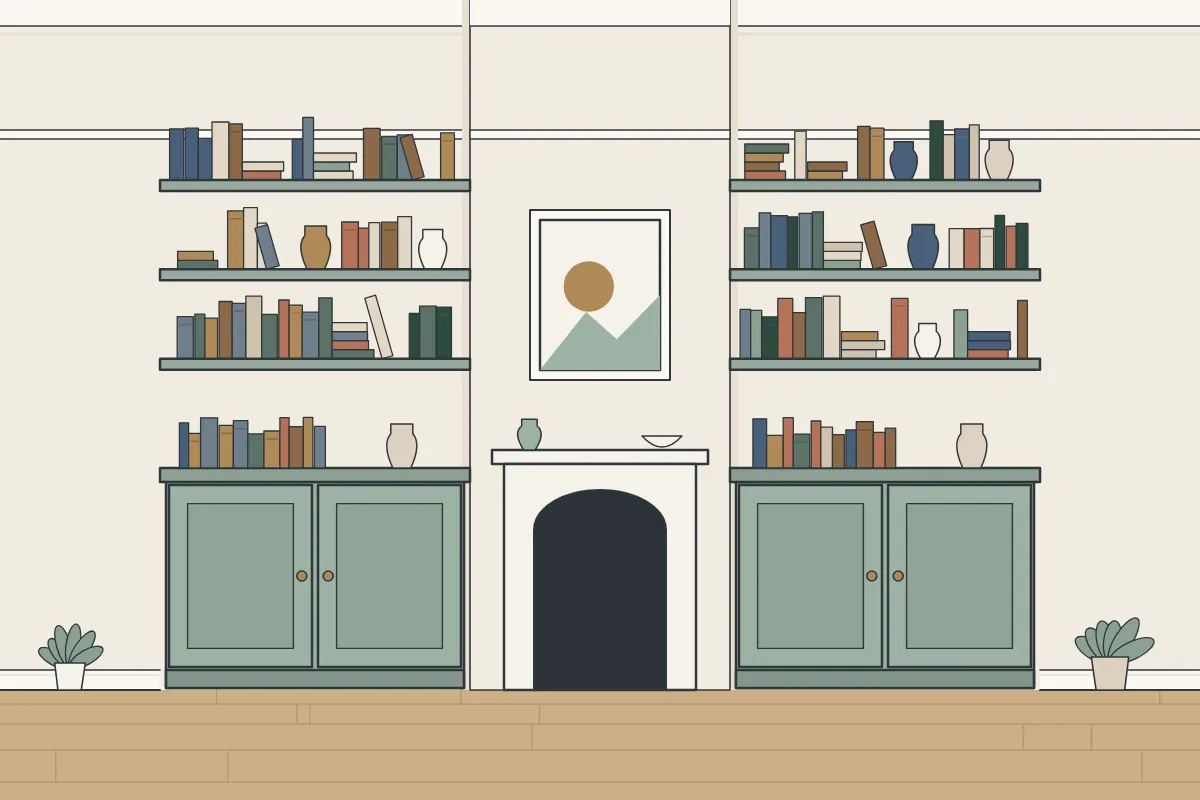
If you live in one of the interwar houses or semis around Gidea Park, the main room is often well proportioned, with a bay, a chimney breast and not many other recesses. That leaves room for alcove units in the alcoves, along a full wall or around the chimney breast. The carcasses are made from moisture-resistant MDF or birch plywood, painted in a colour agreed with you.
After the design visit, we send you a quote in writing. It sets out the design we have talked through, the materials and the finish, so you know exactly what you’re getting.
- Place
- Gidea Park (RM2, RM3, RM1)
- Borough
- Havering
- Price
- Quoted for your room
- First step
- A design visit: we measure and talk it through
- Where it is made
- In our workshop, then fitted in your home
- Materials and finish
- MDF and birch plywood, painted
- Working days
- Weekdays; Saturdays on request
- Contact
- Send us a message
- Page updated
- 27 October 2026
Places near Gidea Park
More for homes in Gidea Park
How it’s made
Birch plywood
Birch plywood is also good for drawer boxes. It is painted to match the rest of the unit, or the edge is left as a detail.
Plinths and scribe strips
In older houses, we normally scribe the sides and often the top too. It’s the difference between a unit that sits in the alcove and one that belongs there.
Fitting day, step by step
Furniture made in a workshop still has to meet the room it’s going into, and fitting day is where that happens. Walls in older homes are rarely flat or square, so we scribe the edges by hand to follow the wall, until the line is tight. How long the fitting itself takes depends on how many alcoves there are and how tall the units go, and the fitting days are set out in your quote. A front path or side gate can make the carry from the van simpler. Gates, paths and steps up to the door are part of the route we measure. Floors are covered from the door to the room.
- You let us know which room it is and roughly what you’d like in the alcoves.
- At the design visit, we measure both alcoves, check the walls and look at the skirting and picture rail. We also talk through heights, doors and shelves.
- You receive a quote with the design, the materials and the paint finish. If anything needs changing, just tell us.
- Once you’re happy, the units are made at our workshop, using moisture-resistant MDF and birch plywood.
- Fitting day: the units go in, are scribed to the alcoves and levelled on a plinth or feet.
Before we arrive
- If you live in a block, book the lift and tell the building manager
- Let us know where the boiler and meters are
- Keep pets out of the room and the hallway
Getting a quote
Getting a quote starts with some details: the room, rough measurements and some photos if you have them. When you are ready, fill in our short enquiry form. After that, we arrange a visit to measure and discuss the design, then send a quote in writing.
Advice
Questions we are often asked
Can parking be tricky on fitting day in Gidea Park?
It depends on the street, as many London boroughs run controlled parking zones. A van may need a visitor’s permit, a paid parking bay or a bay suspension, which the council arranges, often with notice. Let us know what parking is near you at the measuring visit, and we’ll plan around it.
Do you cover homes near Gidea Park station?
Yes. We cover all of Havering and the rest of London. To get started, you can tell us about the room on our contact form with a few details about the room, and tell us about parking and access at the same time.
Does fitted furniture need planning permission?
Not usually. Conservation area controls are mainly about the outside of buildings, and furniture inside a house does not normally need it. In a listed building, check with the council’s conservation officer before any work.
Do I need to be at home on fitting day?
We need someone to let us in. It’s good to have someone there at the end to look over the work with us.
Do alcove units affect the chimney’s ventilation?
We plan alcove units so any chimney vent stays clear. A capped or blocked chimney should still be ventilated to help stop damp, so we never box a vent in.
Do alcove units need to reach the ceiling?
It is up to you. Full-height units give the most storage, while others stop them at the picture rail or leave open shelves above a low cupboard. We’ll go through what suits your room when we visit.
What affects the price in Gidea Park
Prices vary from room to room, and it comes down to:
- How many doors and drawers there are
- Whether you choose a spray or hand-painted finish
- Tricky walls, sloping ceilings and uneven floors
- Hanging rails, shelves, drawers and other fittings inside
The price comes in a written quote, worked out from the measurements and the design you choose. Bigger pieces use more board and take longer to make and fit, so size is the starting point. Doors, drawers, internal fittings and the finish make up most of the rest.
What we need to know
What helps most when you first contact us:
- Pictures of the whole wall or room, including the floor and ceiling
- Your postcode and the borough
- The type of home and how the room is reached
- Radiators, sockets, pipes or meters on or near the wall
Rough measurements are fine at the start. Everything is measured properly when we visit, along with the walls, floor and ceiling. To get started, send us a few details through our contact form and let us know about the room. You receive a written quote after the visit.
The problems alcove units solve
Where a fireplace has been blocked up or removed, the chimney breast can look bare. Units on both sides frame the chimney breast and balance the room.
Here are some of the needs we’re asked about most:
- Shop-bought shelving that does not fill the recess
- Storage that suits a period room
- Worn or badly fitted alcove units
- Walls too uneven for standard furniture
If your home is one of the older houses near St Michael and All Angels Church, the alcoves beside a chimney breast are the natural place for alcove units.
Before you choose who makes it
- Whether you will get a written quote, not just a figure
- Whether the quote follows a visit to your home
- Are the boards named, like MDF or plywood?
- How they deal with uneven walls and floors
Caring for painted furniture
New paint needs time to cure fully, so treat it gently at first. After that, a few simple habits help:
- Plan any new sockets with your electrician before fitting
- Mention parking and access when we visit
- Think about how the units meet the picture rail and cornice
- Have any damp looked at before the units are made
To clean painted units, a soft cloth that’s barely damp is enough. Skip scouring pads and harsh cleaners, as they can mark the finish. Dry the surface afterwards.
Every so often, check that hinges and handles haven’t worked loose, and adjust any door that starts to catch.