
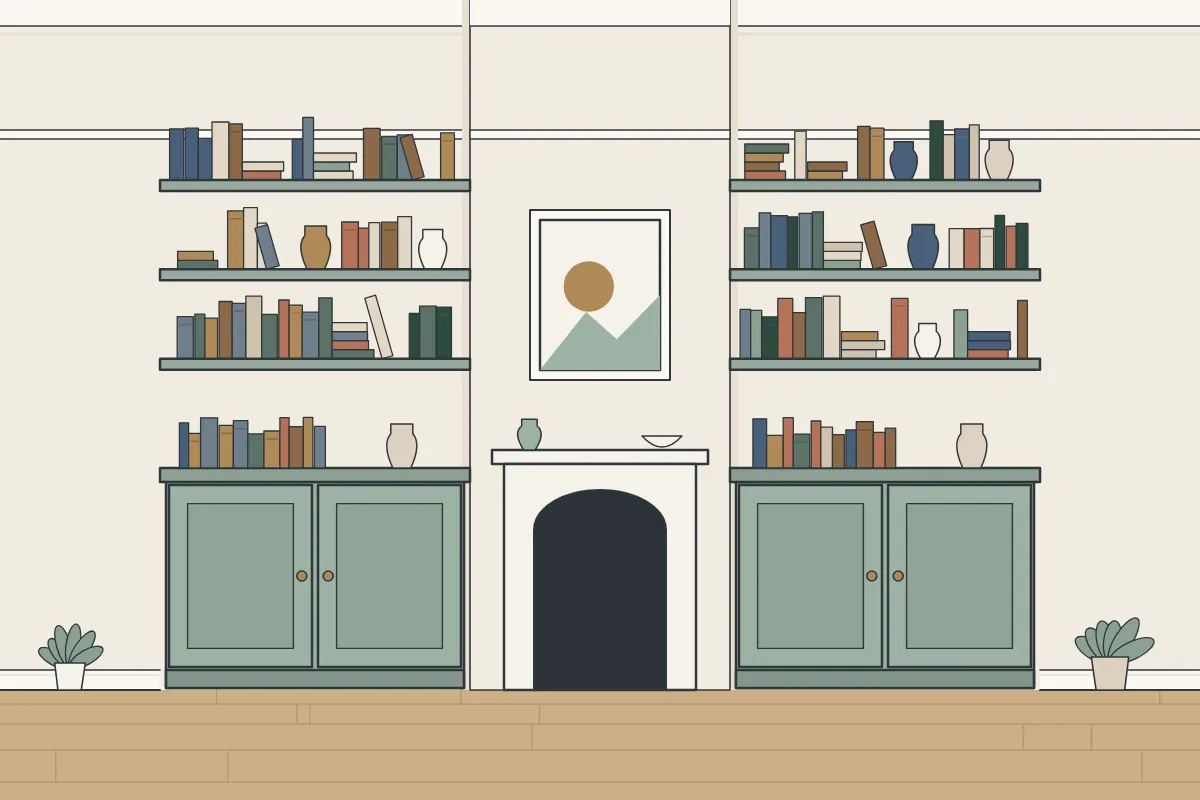
Example photo by Pete Alexopoulos on Unsplash, not our project
Harrow · London
Pinner Green Alcove Units
Cupboards and shelves built into the alcoves beside a chimney breast, for homes in Pinner Green. We measure, design and quote first, then make it in our workshop and fit it.
- Alcoves that are wasted space
- Shop-bought shelving that does not fill the recess
- Tired cupboards in the alcoves
Alcove units for your home in Pinner Green
Alcove units in Pinner Green
Period rooms often have skirting boards, picture rails and cornices. Units can be cut around them, stop just below them or run neatly up to them, whichever suits the room. A plinth can be set to line up with the skirting so the units feel part of the room. We agree these details at the design visit. Most enquiries start with room to work in an alcove and empty alcoves either side of the chimney breast; the furniture is made from birch ply and moisture-resistant MDF, painted by hand or sprayed.
A house from between the wars usually has lower ceilings than a Victorian one, and the proportions of alcove units are set to match. If yours is one of the interwar houses, semis or detached homes that make up much of the housing around Pinner Green, the cornice may be plain or missing, so the furniture can run straight to the ceiling. The skirting is scribed around neatly.
Once you’ve read the quote and decided to go ahead, the furniture is made at our workshop. The quote sets out the agreed design, materials and finish, so every detail can be checked first.
- Where
- Pinner Green (HA5, HA6)
- Area
- Harrow
- Price
- Quoted for your room
- How it starts
- Design visit, then a quote in writing
- Where it is made
- Made in our workshop and fitted on site
- Made from
- Painted MDF and birch ply
- Working days
- Weekdays, and Saturdays by prior arrangement
- Enquiries
- Send us a message
- Last updated
- 27 October 2026
Alcove units in Pinner Green: local notes
About 34% of the homes in the streets around Pinner Green went up between 1945 and 1972, and about 29% between 1919 and 1939, in the VOA’s 2025 council tax stock figures. Each era brings its own kind of wall, ceiling height and floor, so it shapes the design from the first measurement. Part of Pinner Green is in a conservation area, according to Historic England’s records. Conservation area rules mainly cover the outside of buildings, so fitted furniture inside a house doesn’t normally need planning permission. The council can confirm if you’re not sure. Detached and semi-detached houses are home to about 51% of households in the streets around Pinner Green, in the ONS Census 2021 figures. In a semi or detached house, a driveway, where there is one, can make unloading easier.
For a flat near Hatch End station, the route in is measured not just the room, and the sections are sized to fit it. If your children go to Harlyn Primary School or a school nearby, shelving with deep cupboards below keeps books, games and school things in one place. Near listed buildings like Sweetmans Hall, less than half a mile south-east of the centre of Pinner Green, older homes may keep original joinery that alcove units can be designed around. For a listed home, fixing into original features can require listed building consent.
Pinner Green is in the London Borough of Harrow, about 2 miles south-east of Harrow. We cover Pinner Green as part of our work across Harrow. Across Harrow, we cover Pinner Green and the places around it.
Every home in HA5 and HA6 is covered for alcove units, from the main roads to the quieter streets. You’ll find streets here such as Love Lane, Tudor Road and Chapel Lane, and we cover homes on all of them for alcove units. We also cover Pinner (1 mile south-east), Eastcote (1 mile south), North Harrow (2 miles south-east), Roxbourne (2 miles south) and Rayners Lane (2 miles south-east). Across the rest of Harrow, our area takes in Stanmore (4 miles east), Harrow Weald (2 miles east), Wealdstone (3 miles east), Little Stanmore (5 miles east), Greenhill (3 miles east) and South Harrow (3 miles south-east).
What’s near Pinner Green
In Pinner Green, that includes homes near Heathfield School, UTC Heathrow and The Oddfellows Arms. Pinner Green’s nearest station is Hatch End station, roughly 1.3 miles north-east of the centre. Nearby you will also find Heath Robinson Museum (0.5 miles south-east) and Northwood and Pinner Cottage Hospital (0.9 miles north-west).
How fitting works for alcove units
Every fitting follows the same order: floors are protected, the sections come in, everything is levelled, scribed to the walls, fixed and finished. Then the room is tidied and we look over the work with you. How long the fitting takes depends on the size of the alcoves and what goes in them, and we confirm the fitting days in your quote. On fitting day, the sections are carried in, assembled, scribed to the wall and levelled. Spray-painted pieces come finished from the workshop, while hand painting can happen on site. Saturdays can be arranged.
- You send us a few details about the alcoves and what you’d like in them.
- We visit to measure the alcoves and talk through the design.
- You receive a quote in writing setting out the units, materials and finish, for you to read through at your own pace.
- The units are built in our workshop, using moisture-resistant MDF and birch plywood.
- We install the units, set them level and scribe them to the alcoves.
Before fitting day
- Keep pets in another room while we work
- Empty the space we’ll be working in
- Mention any parking restrictions on your street
Ask for a quote
To get a quote, message us from the contact page and tell us a little about the room. We then arrange a design visit to measure and go through the design, and a written quote follows.
Related advice
What it costs
Each piece is designed for one room, so each price is too. What affects it comes down to:
- Spray painting or hand painting
- Parking near your home
- The internal fittings
- The number of doors and drawers
There’s no price list, because every piece is designed for one room. Instead, we measure, talk through the design and then quote in writing. To arrange a design visit, use our contact form.
Getting in touch
What helps most when you first contact us:
- Examples of the look you are after
- How you want to use the space
- Rough sizes, even if they’re only to the nearest few centimetres
- A few photos of the space, taken from the doorway and from each corner
A quote begins with some details from you: which room it is, rough sizes and a couple of pictures if you can take them. When you are ready, tell us about the room on our contact form. After that, we arrange a visit to measure and talk through the design, then send a quote in writing.
Questions we are often asked
Is Pinner Green in the area you cover for alcove units?
Yes. Pinner Green is one of the places we work, along with the rest of Harrow and London. To get started, you can tell us about the room on our contact form with a few details.
Do you cover homes near Hatch End station?
Yes, homes across Harrow and the rest of London are within the area we cover. To get started, you can fill in our short enquiry form with some details about the room, and let us know about parking and access at the same time.
Can you come on a Saturday?
Yes, by prior arrangement. Tell us when you get in touch if a Saturday suits you best.
How long does it take to fit alcove units?
It depends on the size and number of units, and your quote sets out the fitting days. We’ll explain what to expect before we arrive.
Do alcove units affect the chimney’s ventilation?
We design around any vent so it stays open. Ventilation helps keep a capped chimney dry, which protects the units as well as the wall. If there is damp on the breast already, it’s best sorted before fitting.
Does fitted furniture need planning permission?
Not normally. Conservation areas mostly control changes to the outside, and furniture inside a house does not normally need it. In a listed building, check with the council’s conservation officer before any work.
Practical tips
Getting the most from alcove units starts with the planning and carries on after fitting day. Here are some things worth bearing in mind:
- Tell us about parking and access at the design visit
- Decide what goes behind doors and what goes on show
- Move things out of the alcoves so we can measure properly
- Think about how the units meet the picture rail and cornice
To clean painted units, a soft cloth that’s barely damp is enough. Skip scouring pads and harsh cleaners, which can dull or mark the paint. Wipe it dry when you’ve finished.
Now and then, check handles and hinges are still tight and adjust a door before a small rub becomes a mark.
Honest limits
We’re carpenters, so some jobs belong to other trades. These are worth knowing before you plan:
- Making good damaged walls before fitting
- Moving sockets or switches, which needs an electrician
- Decorating the rest of the room
Not sure whether your space suits alcove units? You can get in touch through our contact form and we will tell you. Our process from visit to fitting.
What it is made from
- Birch plywood
- Panelled or flat doors
- Spray-painted finish
- Adjustable shelves
- Moisture-resistant MDF
- Scribed side panels
- Hand-painted finish
Flats, conversions and leaseholders
Conversions and newer flats often have stud walls rather than solid brick. We choose fixings to suit the wall, after checking the walls at the measuring visit.
Leaseholders should check the lease before anything is fixed to the walls. Some leases need the building owner’s consent for alterations. We cannot give advice on leases, so check it yourself or ask your managing agent.