
Barking and Dagenham · London
Under-stairs storage in Dagenham, Barking and Dagenham
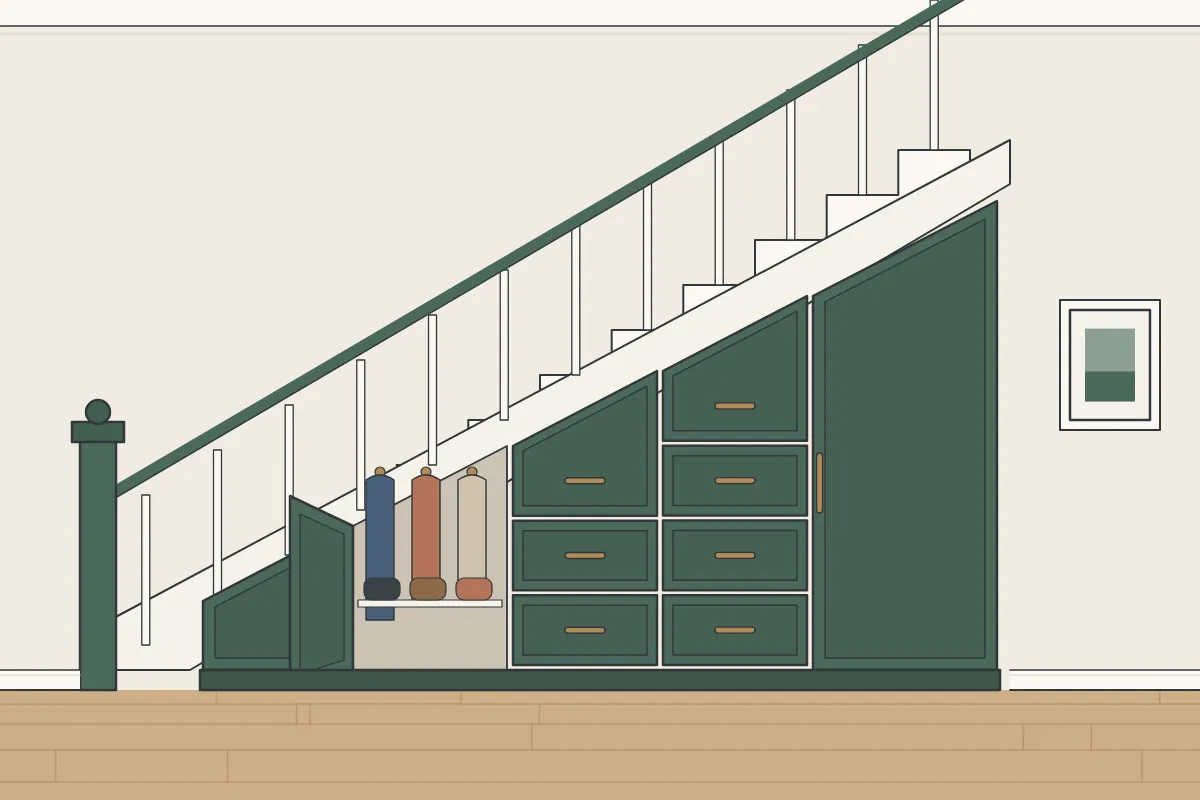
Under-stairs storage for your home in Dagenham: pull-out drawers, cupboards and coat storage under the stairs. We visit to measure and talk through the design, make the furniture in our workshop and fit it.
- A hallway crowded with coats and shoes
- A dark, wasted space under the stairs
- A fuse board that is hard to get to
Under-stairs storage designed for your room
How we make under-stairs storage for Dagenham
Each under-stairs cupboard is built in our workshop, using moisture-resistant MDF and birch plywood. Birch plywood suits drawer boxes and carcasses, as it is strong and holds screws firmly, and MDF gives the doors and fronts a smooth surface for paint. Once painted, by spray or by hand, it is brought to your home in Dagenham and fitted. People typically come to us about a vacuum cleaner that has nowhere to go and an under-stairs cupboard full of clutter; the furniture is made from birch plywood and moisture-resistant MDF with a spray-painted or hand-painted finish.
If you live in one of the interwar houses or semis around Dagenham, the hallway may be wider than in a Victorian terrace, with room for a cupboard by the door. Bays at the front suit a seat with storage below, with a grille so any radiator below keeps heating the room. Under-stairs cupboards are measured and made for the house you have.
The quote names the materials: moisture-resistant MDF, birch plywood or both, depending on the design. The finish is stated too, whether that’s spray painting or hand painting.
- Place
- Dagenham (RM10, RM9, RM13, RM7)
- Area
- Barking and Dagenham
- Prices
- Quoted for your room
- How it starts
- A design visit: we measure and talk it through
- Made
- Workshop-made, then fitted
- Boards and paint
- MDF and birch plywood, painted
- Fitting days
- Weekdays, and Saturdays by arrangement
- Enquiries
- Our contact form
- Last updated
- 27 October 2026
Flats, conversions and leaseholders
In conversions and newer blocks, many internal walls are timber or metal stud with plasterboard. We choose fixings to suit the wall, which we check at the design visit.
Many London terraces have been converted into flats, and that often means a shared hallway and a tight turn on the stairs. Each section is sized with that in mind.
Places near Dagenham
What else we make in Dagenham
Under-stairs storage for homes in Dagenham
About 66% of the homes in the neighbourhood around Dagenham went up between 1919 and 1939, and about 14% between 1945 and 1972, in the VOA’s 2025 council tax stock figures. Each era brings its own kind of wall, ceiling height and floor, so it shapes the design from the first measurement. Near the centre of Dagenham, Historic England’s list includes Church of St Peter and St Paul (Grade II*), under half a mile south-east, and The Vicarage (Grade II), less than half a mile south-east. For a listed home, works inside that affect its character may need listed building consent from the council, for example removing or fixing into original panelling. The council’s conservation officer is the person to ask before work starts. About 47% of households in the streets around Dagenham live in terraced houses, based on Census 2021. Under-stairs cupboards in terraces often house the gas meter, electricity meter or fuse board, so storage is designed to keep them reachable.
If you live near Beam Valley Country Park, under-stairs cupboards can be designed to hold outdoor kit, from walking boots to picnic things. If you live in a flat close to Dagenham Dock station, under-stairs cupboards are made in sections sized for the stairs, landings and lift, so measuring the route matters as much as measuring the room. Rainham Hall, about 2 miles south-east, is one of the historic houses in the wider area. If your own home is a period one, pull-out drawers can reach right to the back of a deep under-stairs space.
Dagenham is about 3 miles west of Barking, in the London Borough of Barking and Dagenham. Whether your home in Dagenham is a terraced house, a flat or a newer build, the furniture is designed around the room as we find it. In Barking and Dagenham, Dagenham is one of the places we cover, and the borough has 11 places on our list.
Design visits and fitting in RM10, RM9, RM13 and RM7 work the same way as everywhere else we cover. You’ll find streets here like Exeter Road, Plumtree Close and Rodwell Place, and homes on each of them are within our area for under-stairs storage. Main roads around Dagenham include the B178, and we plan where the van can stop before fitting day. Nearby, we also make under-stairs storage in Becontree (1 mile north-west), Dagenham Green (1 mile south-west), Beam Park (1 mile south), South Hornchurch (1 mile south-east) and Hornchurch Marshes (2 miles south). We also make under-stairs storage in nearby places such as Barking (3 miles west), Thames View Estate (2 miles west), Barking Riverside (2 miles south-west), Castle Green (2 miles west), Chadwell Heath (3 miles north) and Creekmouth (3 miles south-west).
What’s near Dagenham
We fit furniture in homes around Cross Keys pub and Dagenham Park Community School and the streets around them. For rail, the closest station is Dagenham Dock station, roughly 1.2 miles south-west of the centre. Well-known places in the area include Rush Green Hospital (1.5 miles north-east). For a walk, there is Dagenham Village Churchyard.
Why bespoke in Dagenham?
Period walls are rarely flat, and floors are often out of level. Standard units show the gaps, and filler strips can only hide so much. We scribe each under-stairs cupboard to follow the walls and the stairs, and set it level on a plinth or adjustable feet. The spaces between doors, windows and radiators are seldom a stock size, which leaves ready-made pieces sitting awkwardly. Fitted furniture is designed around them.
Prices are quoted for your room, once we’ve measured and talked through the design. The price depends mainly on the size of the piece, how many doors and drawers it has and what goes inside.
Why us?
- More than 300 projects completed
- Made in moisture-resistant MDF and birch plywood
- Every quote follows a design visit
- We work across all London boroughs
See our comparison of bespoke and off-the-shelf or what to look for in a quote.
Could you do it yourself?
Bespoke work comes into its own in rooms that aren’t square. Older London rooms tend to have leaning walls, sloping floors and alcoves of different widths, and standard units leave gaps.
Shop-bought shelves can sag over a long span. How much a shelf bends depends on its span, depth and load, and long runs need a thicker shelf, a lip along the front or a support. That is something we plan for in the design.
Common questions about under-stairs storage
Do you make under-stairs storage for homes in Dagenham?
Yes. Dagenham is one of the places we work, along with the rest of Barking and Dagenham and London. You can message us from the contact page to arrange a design visit.
Is parking a problem for fitting in Dagenham?
It can be, depending on whether your street is in a controlled parking zone. Depending on the street, a visitor permit, a paid bay or a bay suspension through the council may be needed, and suspensions often need notice. It helps to tell us about parking at the measuring visit, so we can plan the day around it.
Is an outside wall a problem for fitted furniture?
External walls can be colder and damper than internal ones, so we allow for ventilation behind and inside the furniture. If there is damp, it should be sorted before anything is fitted.
Do I need to be in when you fit?
Someone needs to let us in. It’s good to have someone there at the end to look over the work with us.
Can you fit furniture to uneven walls?
It is something we deal with all the time. The furniture is scribed to follow the walls and levelled on feet or a plinth, so it sits tight to the room.
Do you move sockets or add lighting?
No. Sockets, switches and lighting are for your electrician, and some electrical work in homes is covered by Part P of the Building Regulations. We plan the furniture around where they’ll go.
What happens on fitting day
There isn’t much for you to do on fitting day. We need someone to let us in at the start, and the room should already be cleared, as we will have talked about during the design visit. After that, it’s over to us: the floors are covered, the sections come in and the fitting begins. How long the fitting takes depends on the size of the space and the design, and your quote sets out the fitting days. In a 1920s or 1930s house, the hall and stairs are normally straightforward, but the route in is still measured, not just the room. Under-stairs cupboards arrive in sections and are assembled in place.
- First we hear what’s under your stairs now and what you need, like coats, shoes or the vacuum cleaner.
- We measure the space, the slope and the floor, and note any meters or fuse boards.
- We talk through drawers, cupboards and coat storage, and send a written quote.
- The storage is made in our workshop and painted in your colour.
- The storage is fitted, scribed to the stairs and checked with you.
Before fitting day
- Have your electrician move any sockets or switches beforehand
- Clear the hallway and stairs so the sections can come through
- Book any lift and let the concierge or building manager know
Starting with a design visit
If you know what you want, say so; if you don’t, that is fine, and we can work it out together. At the design visit, we measure up and talk the design through with you, and the written quote that follows sets it out. To start, tell us about the room on our contact form.
Advice
Tips worth knowing
Most of what helps is simple. Here’s what we suggest:
- Note the size of anything tall you want to store
- Mention any parking rules on your street
- Bring paint colours you like to the design visit
- Empty the cupboard so we can measure every corner
Once the fitting is done, the storage is ready to use. Paint needs time to cure fully, so treat the new finish gently at first. Avoid sticky tape, heavy knocks and harsh cleaners while it hardens.
Keep the doors and drawers closed when the space isn’t in use. Overfilled drawers put strain on the runners, so it pays to sort them now and then. Deal with any wet shoes or umbrellas before they mark the base.