
Example photo by Pete Alexopoulos on Unsplash, not our project
Greenwich · London
Greenwich Alcove Units
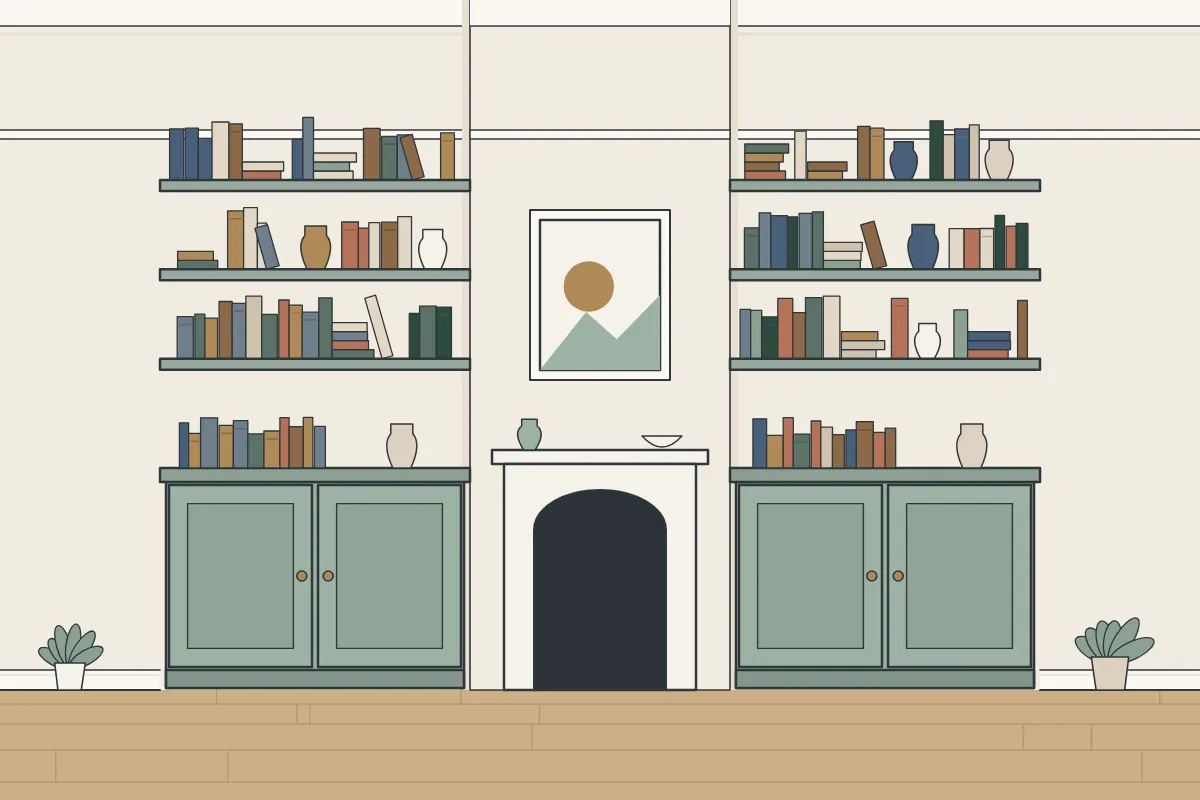
For homes in Greenwich, we make alcove units from moisture-resistant MDF and birch plywood. Each piece is finished by spray or by hand, in the colour you choose.
- Old alcove cupboards that have seen better days
- Storage that suits a period room
- Shop-bought shelving that does not fill the recess
Ask about alcove units in Greenwich
How we make alcove units for Greenwich
Skirting boards, picture rails and coving are common in older rooms. We can cut units around these details, stop beneath them or run up to meet them, depending on the look you want. A plinth can be set to line up with the skirting for a tidy line around the room. We agree these details during the design visit. If you are living with shelving for books and records and clutter with nowhere to go, that is what alcove units are for, made from birch ply and moisture-resistant MDF, painted by hand or sprayed.
Most internal walls in homes from recent decades are plasterboard on studs, and the board will not carry a heavy load on its own. Around Greenwich, where many homes were built since 2000, that shapes how alcove units are fixed: heavier pieces stand on the floor and are fixed back into the studs, and shelves use fixings made for the board where there’s no stud.
The written quote puts the design visit in writing: the layout, what goes inside, the materials used and the finish. If you’d like to change anything, it’s easier before the furniture is made.
- Place
- Greenwich (SE10, SE3, SE8)
- Area
- Greenwich
- Cost
- Quoted for your room
- To begin
- Design visit, then a quote in writing
- Where it is made
- Made in our workshop and fitted on site
- Made from
- MDF and plywood, painted to order
- When we fit
- Weekdays (Saturdays if arranged)
- Get in touch
- Our contact form
- Updated
- 27 October 2026
Where other trades come in
We make and fit furniture, and we do not do electrics, plumbing, gas, plastering or structural work. There are a few other points to bear in mind:
- Finding and fixing the cause of damp
- Electrical work, like new sockets or switches, which is for your electrician
- Making good damaged walls before fitting
If you are not sure what’s possible in your room, you can fill in our short enquiry form and we’ll give you a straight answer. How it works.
What goes into it
- Birch plywood
- Scribed side panels
- Moisture-resistant MDF
- Adjustable shelves
- Spray-painted finish
- Hand-painted finish
- Panelled or flat doors
When is bespoke worth it?
Long shelves are where off-the-shelf often struggles. Span, depth and the weight on it decide whether a shelf sags, so a long run needs a thicker shelf, a stiffening lip or a support. That’s something we plan for in the design.
It is worth being honest about cost: flat-pack is normally cheaper to buy. Bespoke makes more sense where the room is awkward, the space is valuable or you want the furniture to look built in.
Fitting day, step by step
Furniture made in a workshop still has to meet the room it’s going into, and fitting day is where that happens. Few walls in older London homes are truly flat or square, so we scribe the edges by hand to follow the wall, until the line is tight. How long the fitting itself takes depends on the size of the alcoves and what goes in them, and your quote sets out the fitting days. Newer blocks often have concierge desks, entry systems and rules on lift booking, so it is useful to sort them out beforehand. The furniture is built in sections that fit the lift and doorways.
- You send us some details about the alcoves and what you’d like in them, and we arrange a design visit at a time that suits you.
- We visit to measure the alcoves and talk through the design.
- You receive a quote in writing setting out the units, materials and finish.
- The units are built in our workshop, ready for a spray-painted finish or for hand painting on site.
- We fit them in your home, scribing them to the walls, so they sit tight to the chimney breast.
How to prepare
- Let us know if your street is in a controlled parking zone
- Empty the space we’ll be working in
- If you live in a block, book the lift and tell the building manager
Getting a quote
Getting a quote starts with some details: which room it is, rough measurements and a couple of pictures if you can take them. To send them, send us a few details through our contact form. We will then arrange a design visit and follow it with a quote in writing.
Read more
Flats, conversions and leaseholders
In a flat, the route in matters as much as the room. At the design visit, we measure the stairs, the landings, any lift and the doors, so the furniture can be made in sections that fit through.
Many London terraces have been converted into flats, which often brings a shared hall and tight turns on the stairs. Each section is sized with that in mind, after measuring the route during the design visit.
Alcove units in Greenwich: local notes
Homes built before 1919 make up about 36% of the housing in the streets around Greenwich, with about 35% built since 2000, in the VOA’s 2025 council tax stock figures. The age of a home tells us a lot about its walls, floors and ceilings, and so about how alcove units are fixed and fitted. Within a mile of the centre of Greenwich, 4 conservation areas are recorded by Historic England. England has around 10,000 in all, and their controls are mainly about the outside of buildings. Strict stopping rules apply on red routes, which TfL runs. Where a home in Greenwich is on or beside a main road, it helps to mention that during the design visit. That way we can plan where to load and unload.
Queen's House, about 0.2 miles north-west, is one of the historic houses in the wider area. If your own home is a period one, walls that bow and floors that slope are why alcove units are scribed to fit rather than pushed into place. Close to Island Gardens? Alcove units can be arranged to keep the window and the light clear. If your home is as old as some of the listed buildings nearby, like Royal Observatory, original features like shutters, panelling and fireplaces are worth designing around. For a listed home, fixing into original features can require listed building consent.
Greenwich is about 3 miles east of Plumstead, in the Royal Borough of Greenwich. Design visits and fitting in Greenwich can be on a Saturday, by arrangement. Our work takes in places right across the rest of London, large and small.
Every address in SE10, SE3 and SE8 is within our area for alcove units. You will find streets here such as Cade Road, Webb Road and Creek Road, and we cover homes on all of them for alcove units. The A2203 and A2211 run close to Greenwich; on busy main roads, unloading alcove units takes a little planning. We also cover Maze Hill (1 mile north-east), Vanbrugh Park Estate (1 mile east), Blackheath (1 mile south-east), Westcombe Park (1 mile east) and Isle of Dogs (1 mile north-west). Other parts of the rest of London we cover include Plumstead (3 miles east), Eltham (3 miles south-east), Woolwich (3 miles east), Well Hall (3 miles south-east), Coldharbour (4 miles south-east) and Charlton (2 miles east).
Landmarks near Greenwich
We fit furniture in homes around The Plume of Feathers pub, John Roan School and St. Paul's, among other places. Greenwich has its own railway station: Maze Hill station. Other landmarks nearby include Greenwich District Hospital (0.5 miles north-east) and Greenwich Castle (within half a mile south-west). Not far away are Creekside Discovery Centre.
FAQs: alcove units in Greenwich
Do you cover homes near Maze Hill station?
Yes. We cover the whole of London. You can message us from the contact page to arrange a design visit, and tell us about parking and access at the same time.
Will parking be an issue for fitting furniture in Greenwich?
It can be: much of inner London is covered by controlled parking zones. A van may need a visitor permit, a pay-and-display bay or a suspended bay, which the council arranges, often with notice. It’s useful to let us know about parking during the design visit.
Can I send photos before the visit?
Yes. Pictures help us understand the room before the design visit, along with rough sizes. Show anything the furniture has to work around, such as radiators or sockets.
Should alcove units go up to the ceiling?
It is up to you. Full-height units give the most storage, while others stop them at the picture rail or leave open shelves above a low cupboard. We go through the options during the design visit.
What do you do at the measuring visit?
It’s a chance to measure properly and talk through what you’d like. We look at the walls, floors and anything the furniture has to work around, and the written quote comes afterwards.
How do I get started?
Just message us from the contact page. It helps to send rough measurements and a few photos, and we’ll arrange a design visit.
Places near Greenwich
Other services in Greenwich
Materials and finishes
Hand-painted finish
With a hand-painted finish, you see the colour in your own light. Scribed edges and joins are painted along with the rest.
Shelves
Shelf heights are planned around your things so tall books and records have room. Upper shelves can be shallower for a lighter look.