
Example photo by Pete Alexopoulos on Unsplash, not our project
Camden · London
Alcove units in North End, Camden
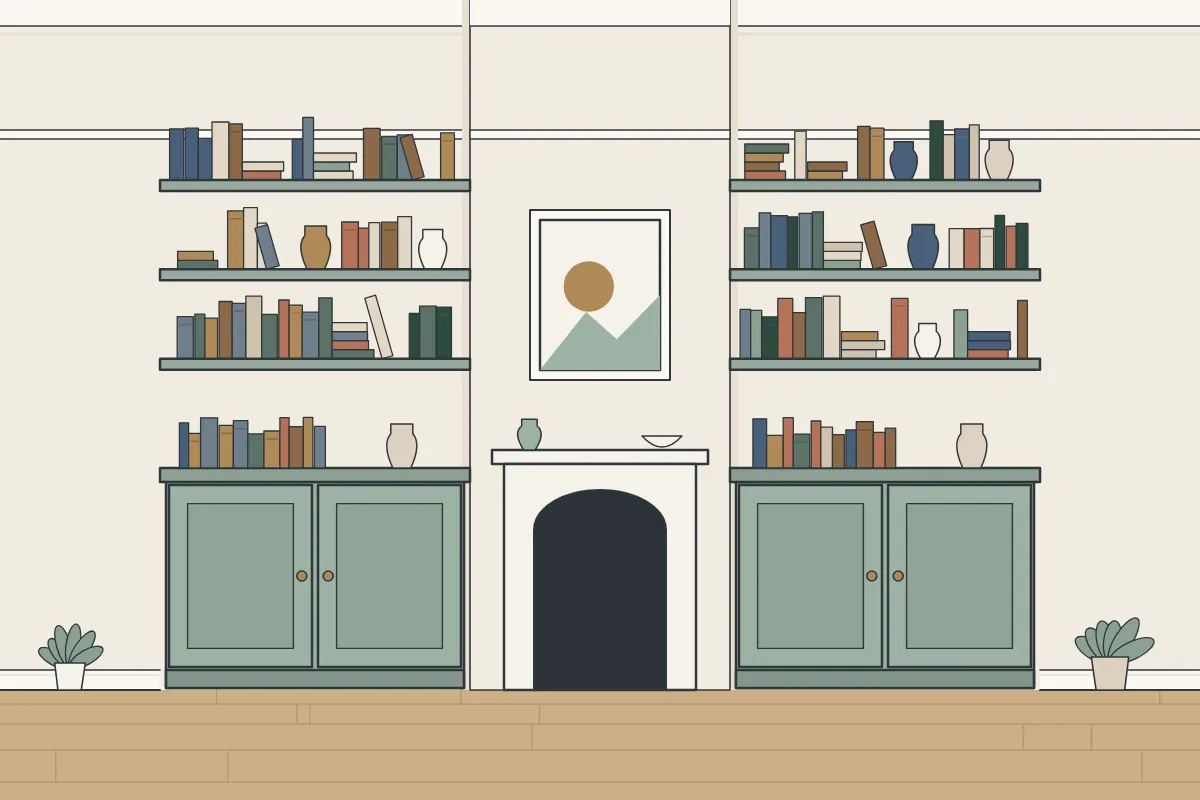
Alcove units for your home in North End: cupboards and shelves built into the alcoves beside a chimney breast. Each piece is designed at a visit to your home, built in our workshop and fitted by us.
- Room to work in an alcove
- Toys and paperwork with no proper home
- Furniture that doesn’t fit the alcove
Alcove units designed for your room
Caring for painted furniture
None of this takes much effort. Here’s what we suggest:
- Talk to your electrician early if you want new sockets
- Let us know about stairs, parking and access early
- Note the sizes of large things you want to store
- Think about how the units meet the picture rail and cornice
Keep a record of the colour for future touch-ups. Small marks on a hand-painted finish are easy to touch up, and it is useful to keep a little of the paint.
If a damp patch appears near a unit, look into it early. The cause is a job for the right trade, not something paint will hide, and it is easier to deal with before it spreads.
About our alcove units in North End
A capped or blocked chimney should still be ventilated to help stop damp. Units are planned so any vent stays clear, with nothing covering it. Any damp in the alcoves should be dealt with by the right trade before the units go in. If your home has alcoves that aren’t square and cupboards in keeping with an older house, alcove units made from MDF made to resist moisture and birch plywood, then spray-painted or hand-painted can solve it.
Picture rails, deep skirting boards and plaster cornices are part of the character of older houses, and they set the lines that alcove units have to meet. A large share of the housing around North End went up before 1919, so mouldings are something we expect to talk about during the design visit. The top line can stop at the rail or run on to the cornice, depending on the room.
Everything we agree at the measuring visit goes into the written quote: the layout, what goes inside, the materials used and the finish. If you’d like to change anything, it is easier before the furniture is made.
- Place
- North End (NW3, NW11, N2)
- Borough
- Camden
- Cost
- Quoted for your room
- How it starts
- A design visit: we measure and talk it through
- Made
- Workshop-made, then fitted
- Materials and finish
- MDF and plywood, painted to order
- Working days
- Weekdays; Saturdays on request
- Enquiries
- Send us a message
- Page updated
- 27 October 2026
Nearby places to North End
More for homes in North End
Where other trades come in
It’s useful to know what’s outside our work before you plan:
- Decorating the rest of the room
- Finding and fixing the cause of damp
- Plastering or repairing loose plaster in the alcoves
If in doubt, you can fill in our short enquiry form and describe the room before you arrange a visit. How it works.
What it’s made from
- Panelled or flat doors
- Scribed side panels
- Hand-painted finish
- Birch plywood
- Moisture-resistant MDF
- Spray-painted finish
- Adjustable shelves
Could you do it yourself?
Off-the-shelf furniture can be a sensible choice. In a room with square walls and standard sizes, it can work well, and it is quick to buy.
Bespoke work comes into its own in rooms that are not square. In period homes, walls lean, floors slope and the alcoves on each side are often different widths, and standard units leave gaps.
From workshop to your room
If anything comes up on the day, just ask. The design, materials and finish were settled before anything was made, so the day itself is about careful fitting and leaving the room tidy. The time the fitting takes depends on the size and number of units, and we confirm the fitting days in your quote. In a period home, the furniture is fitted to walls that are not straight, so each piece is trimmed and adjusted on site. We protect the floors and keep dust to a minimum. It’s useful to let us know about parking at the design visit, as terraced streets are often busy.
- You tell us which room it is and roughly what you’d like in the alcoves, even if the design is only a rough idea so far.
- At the design visit, we measure both alcoves, check the walls and look at the skirting and picture rail. We also talk through heights, doors and shelves.
- We send a written quote setting out the layout, materials and finish. If anything needs changing, just tell us.
- Once you’re happy, the units are made at our workshop.
- Fitting day: the units go in, are scribed to the alcoves and levelled on a plinth or feet. The finish is sprayed in our workshop or hand-painted on site, as agreed.
Getting ready for fitting day
- Mention any parking restrictions on your street
- Move anything in the hall or on the stairs out of the way
- Clear the area where the furniture is going
Arranging a design visit
Getting a quote starts with some details: which room it is, rough measurements and a couple of photos if you can take them. When you are ready, tell us about the room on our contact form. We’ll then arrange a design visit and follow it with a written quote.
Advice
Your questions about alcove units in North End
Can you fit alcove units to the uneven walls of an older house in North End?
Yes. Walls in older houses are rarely flat or square, and floors are often out of level, so each piece is scribed to follow the wall and set level on a plinth or adjustable feet. Skirting, picture rails and cornices are met neatly or cut around. Fixings are chosen for the wall, whether solid brick or lath and plaster.
Do I need permission for fitted furniture in a conservation area?
Normally not: conservation area rules mainly cover the outside of buildings, and fitted furniture inside a house does not normally need planning permission. Listed buildings are different, as works inside that affect their character may need listed building consent from the council. If you’re unsure, the council can confirm.
Do you make the furniture yourselves?
Each piece is made in our workshop for the room it is going into, then brought to your home and fitted. We use moisture-resistant MDF and birch plywood.
Do you work outside London?
No. We work in London and nowhere else, across all the boroughs and the City of London.
Do alcove units affect the chimney’s ventilation?
Any vent in the chimney breast is kept clear when we design the units. A capped or blocked chimney should still be ventilated to help stop damp, so we never box a vent in.
Should both alcoves have the same units?
That’s your choice. Matching units give a balanced, formal look around the chimney breast, but you might want a desk on one side and cupboards on the other. We can keep the details the same so they still look like a pair.
The problems alcove units solve
Often the alcoves are simply the biggest unused space in the room. Standard furniture seldom fits an alcove, leaving gaps at the sides and above. A fitted unit fills the recess up to the ceiling if you want.
Here’s what alcove units can help with:
- Bare alcoves beside the fireplace
- Alcoves that aren’t square
- A desk that tucks into an alcove
- Tired cupboards in the alcoves
Living in a block of flats near Hampstead Heath station? Then check any building rules on lifts and working hours early, and the sections will be sized for the way in.
Questions to ask before you hire anyone
- Whether the quote follows a visit to your home
- How parking will work on your street
- Whether they can show you real projects they’ve done
- Whether the route into your home has been checked
Living-room storage in North End
The biggest shares of homes in the neighbourhood around North End were built before 1919 (about 52%) and between 1919 and 1939 (about 17%), in the VOA’s 2025 council tax stock figures. We take that into account at the measuring visit, since older and newer walls take different fixings. There are 71 entries on the National Heritage List within half a mile of the centre of North End. Original fireplaces, shutters and panelling are worth keeping where they survive, and the furniture can be designed around them rather than over them. Parking on many inner London streets is controlled, with zones run by each borough. A van working in North End will usually need a visitor permit, a paid bay or a bay suspension arranged through the council, which often needs notice. Let us know about parking near your home during the design visit.
If your home is as old as some of the listed buildings nearby, such as The Hill Garden Central Temple Summerhouse, original features like shutters, panelling and fireplaces are worth designing around. For a listed home, fixing into original features may need listed building consent. The wider area includes historic houses like Heath House, about 0.3 miles south. For a period home anywhere nearby, picture rails and cornices give alcove units a line to finish at.
North End is within the London Borough of Camden, about 4 miles south-east of St Pancras. We cover North End as part of our work across Camden. Our Camden coverage includes North End.
Postcode districts we cover here for alcove units: NW3, NW11 and N2. You will find streets here like Sandy Road, Park Avenue and Platt's Lane, and homes on each of them are within our area for alcove units. The A502 runs close to North End, so if your home is on a main road, mention it when you contact us. We also cover Vale of Health (1 mile south-east), Childs Hill (1 mile south-west), Golders Green (1 mile north-west), Greenhill (1 mile south) and West Hampstead (1 mile south). Other parts of Camden we cover include St Pancras (4 miles south-east), West End (4 miles south-east), St Giles (4 miles south-east), Seven Dials (4 miles south-east), Holborn (4 miles south-east) and Bloomsbury (4 miles south-east).
What’s near North End
Our area takes in the homes around Christ Church Primary School, The Old Bull and Bush pub and The Henrietta Barnett School. For rail, the closest station is Hampstead Heath station, about 1.1 miles south-east. Well-known places in the area include Kenwood House (0.6 miles east) and O2 Centre (1.4 miles south). For a walk, there is Parliament Hill and Turner's Wood.