
Tower Hamlets · London
Under-Stairs Storage in Limehouse
Pull-out drawers, cupboards and coat storage under the stairs, for homes in Limehouse. We measure, design and quote first, then make it in our workshop and fit it.
- A low corner too deep to reach into
- An old cupboard door that doesn’t suit the hall
- Coats and shoes piling up in the hall
Need under-stairs storage in Limehouse?
Under-stairs storage in Limehouse
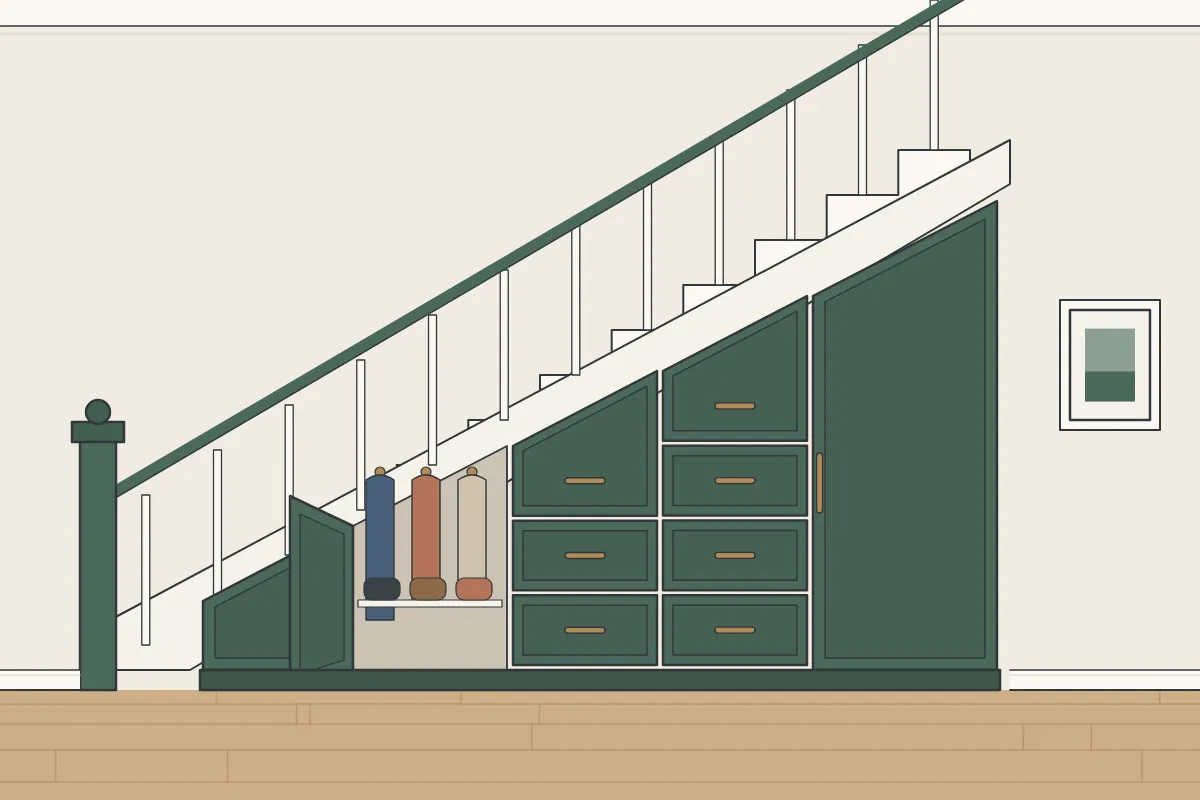
Under the stairs is where so much ends up, from coats and shoes to the vacuum cleaner. We design under-stairs storage around the things you actually want to keep there, with pull-out drawers, cupboards or a combination of the two. In Limehouse, as everywhere we work, it begins with a visit to measure and plan. People normally come to us about an old cupboard door that doesn’t suit the hall and struggling to reach the gas or electricity meter, and the answer is made at our workshop from birch plywood and moisture-resistant MDF with a spray-painted or hand-painted finish.
Hallways in newer flats and houses are often short, with doors opening off every side, so there may be only one useful stretch of wall. With many homes around Limehouse built since 2000, the hall is often where we look first. Even a shallow run can hold coats and shoes without crowding the doors.
Materials are named in the quote: moisture-resistant MDF, birch plywood or both, depending on the design. The finish is stated too, whether that’s spray painting or hand painting.
- Place
- Limehouse (E14, E3, E1)
- Area
- Tower Hamlets
- Prices
- Quoted for your room
- First step
- Design visit, then a quote in writing
- Making
- Made in our workshop and fitted on site
- Boards and paint
- Painted MDF and birch ply
- Working days
- Weekdays, and Saturdays by arrangement
- Enquiries
- The contact form
- Updated
- 27 October 2026
What affects the cost of under-stairs storage
Every room is different, so every job is quoted on its own. This is what makes the difference:
- The overall size of the piece
- Where a van can park, such as a permit bay or a bay suspension
- How easy it is to get the furniture into the room
- The finish: spray painted or hand painted
Every room is priced on its own, because the size, the layout and the finish all vary. A spray finish and a hand-painted finish involve different work, and that shows in the price. You will see the figure in your written quote, after the design visit.
Before the design visit
What helps most when you first contact us:
- Examples of the look you are after
- What you’d like to store or use the space for
- The type of home and how the room is reached
- Rough measurements, even if they’re only to the nearest few centimetres
If you know what you want, say so; if not, we can work it out together at the visit. At the design visit, we measure up and talk the design through with you, and the written quote that follows sets it out. To start, drop us a line using the contact form.
Storage in Limehouse homes: local notes
Homes built since 2000 make up about 42% of the housing in the streets around Limehouse, with about 24% built between 1945 and 1972, in the VOA’s 2025 council tax stock figures. It’s a good starting point, though every room is still measured, as two homes of the same age rarely match. There are 85 entries on the National Heritage List within half a mile of the centre of Limehouse. Original fireplaces, shutters and panelling are worth keeping where they survive, and the furniture can be designed around them rather than over them. About 42% of homes in the area around Limehouse were built since 2000, based on the Valuation Office Agency’s 2025 council tax data. Newer homes often have little built-in storage, and their walls are usually plasterboard on studs, so under-stairs cupboards are designed with fixings to suit.
Close to Bartlett Park? Living near green space often means muddy boots, bikes and outdoor kit, and under-stairs cupboards can give those things a place. For a flat near Limehouse station, the lift, the stair turns and the front door all set the largest piece that can come in.
Limehouse is about 2 miles west of Whitechapel, part of the London Borough of Tower Hamlets. Our work covers every London borough and the City of London, Limehouse included. Our work takes in places right across Tower Hamlets, from the busiest high streets to quiet residential roads.
In E14, E3 and E1, the process is the same as anywhere else in London. We cover homes on streets like Oak Lane, Bale Road and Wharf Lane, along with the roads around them, whether you want under-stairs storage or another piece made for the room. The A126 runs close to Limehouse; on busy main roads, unloading under-stairs cupboards takes a little planning. Neighbouring places we cover for under-stairs storage include Bow Common (1 mile east), Mile End (1 mile north), Ratcliff (1 mile south-west), Stepney (1 mile west) and Shadwell (1 mile south-west). Elsewhere in Tower Hamlets, we also cover Whitechapel (2 miles west), Spitalfields (2 miles west), Tower Hill (2 miles west), Bethnal Green (2 miles north-west), Cambridge Heath (2 miles north-west) and Isle of Dogs (2 miles south).
Landmarks near Limehouse
In Limehouse, that includes homes near Stepney Green Mathematics and Computing College and Star Of The East Public House, among other places. Limehouse has its own railway station: Limehouse station. Other landmarks nearby include Tower of London (2 miles west) and Surrey Quays Shopping Centre (1.6 miles south-west). For a walk, there is Lavender Pond.
Is it time for under-stairs storage?
The most common reason is clutter. Under the stairs is easy to fill and hard to sort, with things pushed to the back and lost in the dark. Purpose-made drawers and shelves give everything its own place, so you can find what you need without emptying the cupboard.
Common reasons to get in touch include:
- A vacuum cleaner that has nowhere to go
- Space under the stairs that is hard to use
- No room for a small desk or a place to work
- A fuse board that’s hard to get to
Near listed buildings like Church of St Anne, under half a mile south of the centre of Limehouse, older homes may keep original joinery that under-stairs cupboards can be designed around. If your own home is listed, check with the council before fixing into original features.
What to check before you book
- Whether the quote says what the furniture is made from
- Will other trades be needed, and who arranges them?
- Have they thought about parking near you?
- How they handle walls that aren’t straight
When you need someone else
Before you plan the job, it’s useful to know what we do not do:
- Electrical work under the stairs, which your electrician carries out
- Gas pipework, which needs an engineer on the Gas Safe Register
- Structural changes to the staircase itself
If you are not sure what’s possible in your room, you can get in touch through our contact form and we’ll give you a straight answer before you arrange a visit. Our process from visit to fitting.
Boards, parts and finishes
- Moisture-resistant MDF
- Spray-painted finish
- Pull-out drawers
- Birch plywood
- Hand-painted finish
- Coat hooks and shoe shelves
From workshop to your room
Period rooms often have skirting boards, picture rails, cornices or coving for the furniture to meet. On fitting day, we cut and scribe the furniture around these details. The time the fitting takes depends on the size of the space and the design, and the fitting days are agreed in your quote. Stud walls can carry pipes and cables, so we check before drilling, and heavy pieces are fixed into the studs or stand on the floor. Any new sockets or plumbing are for your electrician or plumber.
- First we hear what’s under your stairs now and what you need, like coats, shoes or the vacuum cleaner.
- We measure the space, the slope and the floor, and note any meters or fuse boards.
- The design is agreed and a written quote follows.
- The storage is built in our workshop and painted in your colour.
- We fit it in your home and check every drawer and door with you. The way to any meters is left clear.
How to prepare
- Mention any parking restrictions on your street
- Check the building’s rules for trades and lift bookings
- Have your electrician move any sockets or switches beforehand
Starting with a design visit
We quote once we have seen the room. We measure the space, check the walls and floors and discuss what you’d like, and the written quote comes after. The price comes in a written quote, worked out from the measurements and the design you choose. To book a design visit, drop us a line using the contact form.
Read more
Common questions about under-stairs storage
Will a conservation area stop me having under-stairs storage fitted in Limehouse?
Not normally. Conservation area controls are mostly concerned with the outside of buildings, so fitted furniture inside a house doesn’t normally need planning permission. Listed buildings are different, as works inside that affect their character may need listed building consent from the council. If you are unsure, the council can confirm.
Is parking a problem for fitting in Limehouse?
It can be, as controlled parking zones cover much of inner London. A van may need a visitor permit, a paid bay or a parking bay suspension, which the council arranges, often with notice. Let us know what parking is near you at the design visit.
Is it possible to fit storage around a meter under the stairs?
Yes. We plan the storage so the meter or fuse board stays easy to reach, typically behind its own door. Meter readers and engineers need access, so we never box them in.
Which works best under the stairs, drawers or cupboards?
The answer depends on your stairs and what you will keep there. Drawers make the low end useful, because you pull the back of the space to you. At the tall end, a cupboard is often better for coats and the vacuum.
Do you do the electrics?
No. Sockets, switches and lighting are for your electrician. We plan the furniture around where they’ll go.
Do I need to be in when you fit?
We need someone to let us in. It also helps to have someone around at the end, so we can go over the finished furniture together.
What it is made from
Spray-painted finish
Spraying gives a smooth, even surface. It is done in our workshop, before the storage comes to your home. The colour is agreed with you.
Plinths and scribe strips
Scribe strips are trimmed to follow the wall, closing the gap a standard unit would leave. They help the storage look as though it was always there. At floor level, the plinth hides any slope in the floor.