
Example photo by Pete Alexopoulos on Unsplash, not our project
Islington · London
Alcove Units in Highbury
Planning alcove units for a home in Highbury? It starts with a design visit to measure and talk through ideas, then a written quote, before anything is made.
- Walls too uneven for standard furniture
- Old alcove cupboards that have seen better days
- Alcoves that are wasted space
Alcove units designed for your room
Questions we are often asked
Can you fit furniture in a home close to Canonbury station?
Yes, homes across Islington and the rest of London are within the area we cover. You can tell us about the room on our contact form to arrange a design visit, and tell us about parking and access at the same time.
Is parking a problem for fitting in Highbury?
It can be: much of inner London is covered by controlled parking zones. Depending on the street, a visitor permit, a paid bay or a bay suspension through the council may be needed, and suspensions often need notice. It is useful to tell us about parking at the measuring visit, so we can plan the day around it.
Do I need permission in a conservation area?
Not normally. Conservation area controls are mainly about the outside of buildings, and furniture inside a house does not normally need it. In a listed building, check with the council’s conservation officer before any work.
Should both alcoves have the same units?
That depends on how you use the room. The two alcoves are often slightly different sizes, so each unit is made for its own recess. They can share a style while doing different things.
Do you work on Saturdays?
Yes, we can arrange Saturdays. Let us know when you first get in touch.
How do I get started?
The first step is to get in touch through our contact form and let us know about the room. After that, we arrange a design visit and follow it with a written quote.
Alcove units in Highbury: what you get
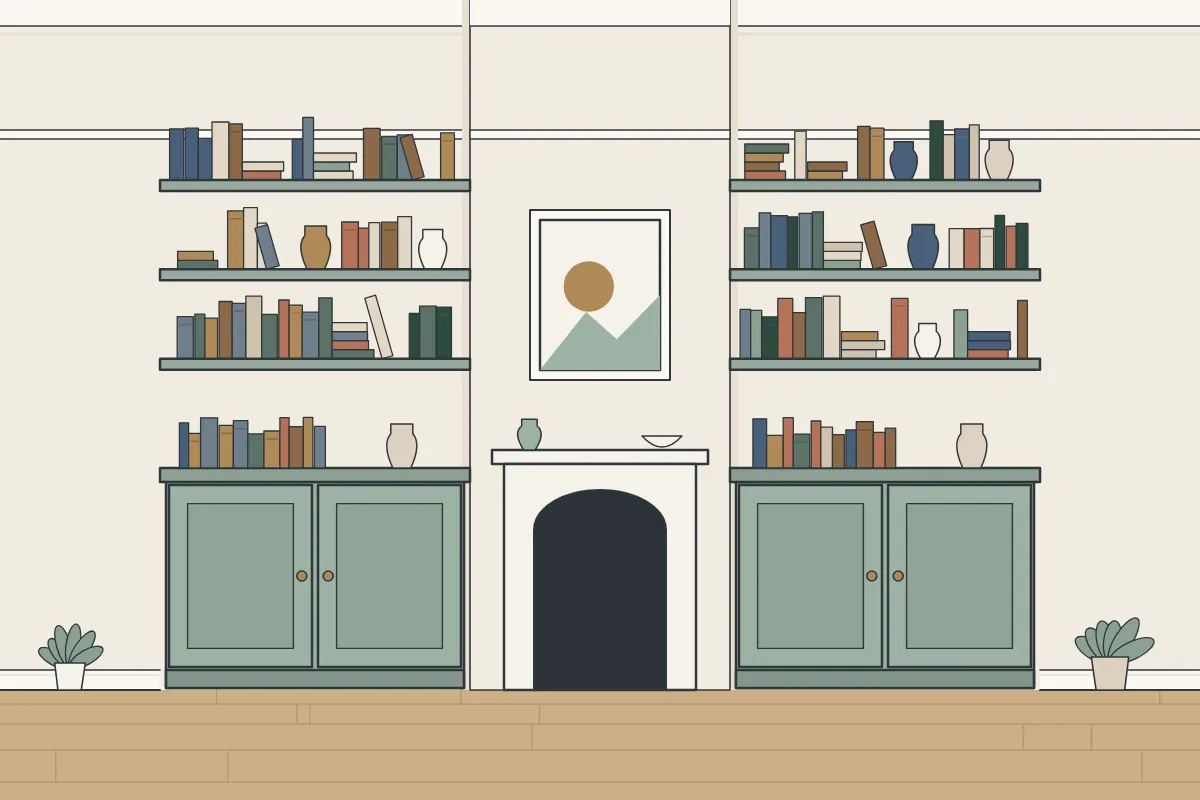
In a typical Victorian or Edwardian terrace, the chimney breast leaves an alcove on either side of it. Built-in alcove units put that space to work as cupboards and shelving that sit as part of the room. If your home in Highbury has alcoves like these, each alcove gets a unit designed for it after we have measured them at a design visit. If you are living with worn or badly fitted alcove units and furniture that doesn’t fit the alcove, alcove units made from birch plywood and moisture-resistant MDF with a spray-painted or hand-painted finish can solve it.
Victorian and Edwardian houses were built with solid brick outside walls, and internal walls may be brick or lath and plaster. Since a large share of the homes around Highbury date from before 1919, the wall type is checked before any fixing for alcove units is chosen. Lath and plaster in particular needs fixings chosen for it, especially behind loaded shelves.
The furniture is made in our workshop after you have had the quote and decided to go ahead. It describes the design, the materials and the finish agreed at the visit, so you can check every detail beforehand.
- Location
- Highbury (N1, N16, N5)
- Borough
- Islington
- Price
- Quoted for your room
- First step
- A design visit: we measure and talk it through
- Where it is made
- Workshop-made, then fitted
- Made from
- Painted MDF and birch ply
- Working days
- Weekdays (Saturdays if arranged)
- Get in touch
- The contact form
- Updated
- 27 October 2026
Alcove units in Highbury: local notes
About 50% of the homes in the neighbourhood around Highbury went up before 1919, and about 18% between 1945 and 1972, based on the Valuation Office Agency’s 2025 council tax data. The age of a home tells us a lot about its walls, floors and ceilings, and so about how alcove units are fixed and fitted. The National Heritage List has 92 entries within half a mile of the centre of Highbury. Older homes nearby may have original joinery, shutters or panelling worth keeping, and the furniture can be designed around them rather than over them. About 29% of households in the neighbourhood around Highbury live in flats in converted or shared houses, going by Census 2021 figures from the ONS. In a converted house, rooms can be odd shapes, with new partitions meeting old walls, and the way in often goes up shared stairs. A lease can require consent for alterations, so it is worth checking yours first.
If your children go to Highbury Quadrant Primary School or a school nearby, low doors that small hands can open, with books and ornaments higher up, suit a busy family room. If your home is as old as some of the listed buildings nearby, such as Union Chapel, original features like shutters, panelling and fireplaces are worth designing around. If your own home is listed, check with the council before fixing into original features.
Highbury is within the London Borough of Islington. Wherever you are in Highbury, the process is the same: a design visit, a quote in writing, furniture made at our workshop and fitting in your home. In Islington, Highbury is one of the places we cover, and the borough has 17 places on our list.
Postcode districts we cover here for alcove units: N1, N16 and N5. You’ll find streets here like Prah Road, Dove Road and Lough Road, and homes on each of them are within our area for alcove units. The A1199 runs close to Highbury, so if your home is on a main road, mention it when you get in touch. We also cover the places around Highbury: Newington Green (1 mile east), Mildmay (1 mile east), Canonbury (1 mile south-east), De Beauvoir Town (1 mile south-east) and Stoke Newington (1 mile north-east). We also make alcove units in nearby places such as Farringdon (2 miles south), Clerkenwell (2 miles south), Finsbury (2 miles south), St Luke's (2 miles south), Upper Holloway (2 miles north-west) and Tufnell Park (2 miles west). Highbury is one of the larger places we cover in Islington.
Local landmarks in Highbury
Around Highbury, we cover homes near The Snooty Fox pub, City of London Academy Highbury Grove and Musical Theatre Academy and the streets around them. Highbury has its own railway station: Canonbury station. Nearby you will also find Arsenal Football Club Museum (0.6 miles north-west) and Hackney Walk (2 miles east). For a walk, there’s Gillespie Park.
Also near Highbury
More for homes in Highbury
Why people ask for alcove units in Highbury
Often the alcoves are simply the biggest unused space in the room. Off-the-shelf furniture rarely fits them, leaving gaps at the sides and above. A fitted unit fills the recess from wall to wall.
These come up often when people first get in touch:
- Bowed walls and sloping floors
- Shop-bought shelving that doesn’t fill the recess
- Cupboards in keeping with an older house
- Room to work in an alcove
For a flat near Canonbury station, the lift, the stair turns and the front door all set the largest piece that can come in.
Questions to ask before you hire anyone
- A quote in writing that sets out the job
- Whether the route into your home has been checked
- Which parts of the job need an electrician or a plumber
- Do they scribe the furniture to the walls?
Flats, conversions and lettings
For a rented home, access for the design visit and fitting day has to be agreed with the tenants, at times that suit them. An agent can arrange access for you, and the written quote can go to whoever needs it.
If your building is on a red route or a busy main road, unloading takes some planning. TfL runs the red routes, and the stopping rules are strict, so let us know about it at the design visit.
Where other trades come in
Before you plan the job, it helps to know what we do not do:
- Taking out a chimney breast or opening up a fireplace
- Painting the walls, ceiling and woodwork around the units
- Plastering or repairing loose plaster in the alcoves
If you’re not sure what’s possible in your room, you can send us a few details through our contact form and we’ll give you a straight answer. How a job runs, step by step.
Boards, parts and finishes
- Moisture-resistant MDF
- Scribed side panels
- Birch plywood
- Panelled or flat doors
- Adjustable shelves
- Spray-painted finish
- Hand-painted finish
Practical tips
Fresh paintwork takes a while to cure fully, so treat it gently at first. Beyond that, these tips help:
- Let us know about stairs, parking and access early
- Sort out damp patches before fitting
- Decide whether the units stop at the picture rail or run to the ceiling
- Move things out of the alcoves so we can measure properly
Paint is dry to the touch well before it has fully cured. At first, go gently with the new paintwork, lifting things rather than sliding them and avoiding any scrubbing.
If a damp patch appears near a unit, look into it early. Damp needs its cause fixing by the right trade.
How fitting works for alcove units
You will not need to do much on the day. Someone needs to let us in, and the room should already be cleared. After that, it is over to us: the floors are covered, the sections come in and the fitting begins. How long fitting takes depends on how many alcoves there are and how tall the units go, and your quote sets out the fitting days. On fitting day, edges are trimmed on site to follow the walls, so we ask for a clear space to work near the room. Dust is kept down and cleared up as we go. Hand painting, if that’s your finish, can follow the fitting.
- You contact us about the alcoves you want to fill.
- We come to measure and talk through cupboards, shelves, heights and doors.
- We put the design, materials and finish into a written quote.
- We build the units in our workshop, using moisture-resistant MDF and birch plywood.
- The units are fitted in your home, ready to fill. Any scribing to the walls is done on the day.
Preparing the room
- Get any new sockets or wiring done by your electrician before fitting day
- Empty the space we will be working in
- Clear the hallway and stairs so the sections can come through
Starting with a design visit
You do not need exact measurements to get started. Everything is measured properly when we visit, including how level the floor and ceiling are. To arrange it, fill in our short enquiry form with a few details about the room. You receive a quote in writing after the visit.