
City of London · London
Under-Stairs Storage in Barbican Estate
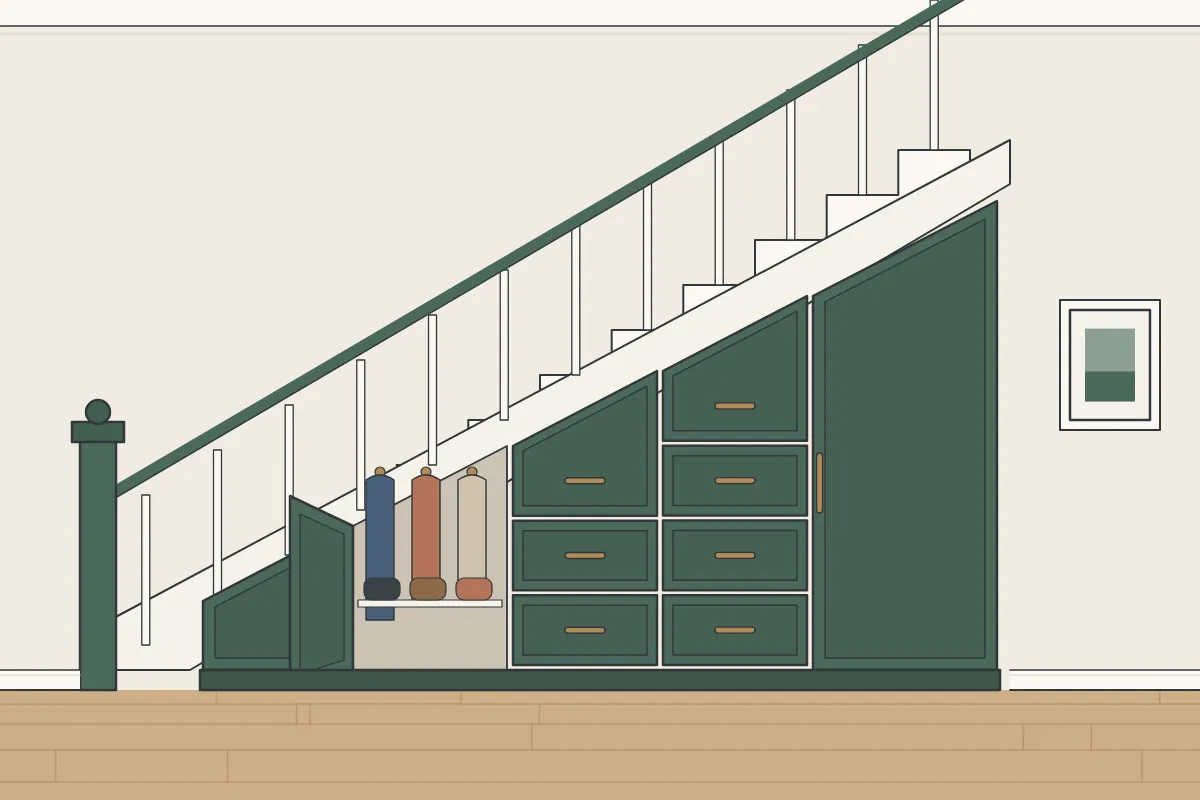
Pull-out drawers, cupboards and coat storage under the stairs, for homes in Barbican Estate. After a design visit and a quote in writing, it is made in our workshop and fitted in your home.
- Needing a compact spot for a laptop
- A low corner too deep to reach into
- Space under the stairs that is hard to use
Under-stairs storage in Barbican Estate
What we don’t do
As carpenters, we leave some work to other trades. It helps to know these before you plan the job:
- Any work on gas pipes or appliances
- Electrical work under the stairs, which your electrician carries out
- Reshaping or rebuilding the staircase
Not sure whether your space suits under-stairs storage? You can get in touch through our contact form and we will tell you. How a job runs, step by step.
Boards, parts and finishes
- Hand-painted finish
- Moisture-resistant MDF
- Spray-painted finish
- Coat hooks and shoe shelves
- Birch plywood
- Pull-out drawers
Under-stairs storage in Barbican Estate
Where the space under the stairs opens onto a room, a compact desk can fit beneath it. A built-in desk with shelving and drawers can turn the space into a quiet corner for paperwork. Any new socket or light there is for your electrician, and we leave room and a route for the cable. It is worth talking through at the design visit in Barbican Estate. If your home has stairs open to a room, with clutter on show and nowhere to put coats, shoes and bags, under-stairs cupboards made from moisture-resistant MDF and birch plywood, finished by spray or by hand can solve it.
Post-war housing makes up a good share of the homes around Barbican Estate, and in London that can mean houses or flats in blocks. Post-war houses typically have space under the stairs that can do more, while in a flat, the hallway and any recess are the places to look. Any meters, fuse boards or boilers stay reachable, with the clearances their makers set out.
Once you have read the quote and decided to go ahead, the furniture is built in our workshop. The quote sets out the agreed design, materials and finish, so you can check every detail beforehand.
- Location
- Barbican Estate (EC1V, EC2A, EC1Y)
- Borough
- City of London
- Price
- Quoted for your room
- First step
- Design visit, then a written quote
- Made
- In our workshop, then fitted in your home
- Made from
- MDF and plywood, painted to order
- Fitting days
- Weekdays (Saturdays if arranged)
- Contact
- Our contact form
- Last updated
- 27 October 2026
FAQs: under-stairs storage in Barbican Estate
Is Barbican Estate in the area you cover for under-stairs storage?
Yes, we work across the City of London, Barbican Estate included, and across the rest of London. To get started, you can drop us a line using the contact form with a few details.
Do you cover homes near Moorgate station?
Yes. We cover all of the City of London and the rest of London. To get started, you can drop us a line using the contact form with some details about the room.
Can you fit furniture to uneven walls?
That’s normal in older homes, and it’s what scribing is for. We scribe the edges to follow the wall and set the furniture level on adjustable feet or a plinth.
Do pictures help?
Yes. They give us a feel for the space before we visit, along with rough measurements. Show anything the furniture has to work around, like radiators or sockets.
Do you do the electrics?
No. Electrical work isn’t something we do; it is a job for your electrician. We can allow for cable routes in the design, and new sockets should be in place before fitting day.
What does an under-stairs cupboard cost?
Because every job is different, the cost is set out in a written quote after the visit. The size of the space, the number of drawers and doors, and the finish all shape the price. To get a quote, message us from the contact page and we will arrange a design visit.
Also near Barbican Estate
Other services in Barbican Estate
From workshop to your room
However carefully a piece is made in the workshop, it still has to meet the room, and that happens on fitting day. Walls in older homes are rarely flat or square, so we scribe the edges by hand to follow the wall. How long the fitting itself takes depends on how much storage you want under the stairs, and the fitting days are agreed in your quote. Drilling into concrete is noisier than into brick or plaster, so if neighbours are close, a note before fitting day can help. We work within any rules your building has on noise and hours. Dust is kept down and cleared as we go.
- First we hear what’s under your stairs now and what you need, such as coats, shoes or the vacuum cleaner.
- We measure the space, the slope and the floor, and note any meters or fuse boards, because they must stay accessible.
- We talk through drawers, cupboards and coat storage, and send a quote in writing.
- Every part is built in our workshop, ready for a spray-painted or hand-painted finish.
- We fit it in your home and check every drawer and door with you.
Preparing the room
- If you live in a block, book the lift and tell the building manager
- Empty the space we’ll be working in
- Have your electrician move any sockets or switches beforehand
Ask for a quote
You don’t need exact measurements to get started. Everything is measured properly when we visit. To get started, drop us a line using the contact form. You receive a quote in writing after the visit.
Advice
Making use of awkward spaces in Barbican Estate
The biggest shares of homes in the streets around Barbican Estate were built since 2000 (about 33%) and between 1945 and 1972 (about 31%), based on the Valuation Office Agency’s 2025 council tax data. It is a good starting point, though every room is still measured, as two homes of the same age rarely match. Entries on the National Heritage List near the centre of Barbican Estate include Church of St Giles (Grade I), less than half a mile south-east, and Church of St Botolph (Grade I), less than half a mile south-west. Works inside a listed home that affect its character, for example removing original joinery or fixing into it, can require listed building consent from the council. The council’s conservation officer is the person to ask before work starts. In inner London, a large part of the street parking sits inside borough-run controlled parking zones. In Barbican Estate, a van will usually need a visitor permit, a paid bay or a suspended bay, and the council arranges suspensions, often with notice. We ask about parking during the design visit, so the van can be planned for.
The wider area includes historic houses like Mansion House, about 0.5 miles south-east. If your own home is a period one, the cupboard door under a period staircase can be kept or replaced to match the new storage. If you live near Barbican Conservatory, living near green space often means muddy boots, bikes and outdoor kit, and under-stairs cupboards can give those things a place. For an older house near St Giles-without-Cripplegate, the triangle under an old staircase is often deeper than it looks.
Barbican Estate is about 1 mile south of City of London, part of the City of London. Barbican Estate is part of the area we cover. Across the City of London, we cover Barbican Estate.
Design visits and fitting in EC1V, EC2A and EC1Y work the same way as everywhere else we cover. Our area takes in homes on streets such as Oat Lane, Shoe Lane and Long Lane, whether you want under-stairs storage or another piece made for the room. Main roads around Barbican Estate include the A1 and A40. If your home is on one of them, tell us at the design visit, as some main roads have strict stopping rules. We also cover Finsbury (1 mile north), City of London (1 mile south), St Luke's (1 mile north), Bishopsgate (1 mile east) and Aldgate (1 mile south-east).
Local landmarks in Barbican Estate
The streets we cover here include those near The Jugged Hare pub, Charterhouse Square School and Barts Health Archives and the streets around them. There is a railway station in Barbican Estate itself: Moorgate station. A little further out are Montfichet's Tower (0.5 miles south-west) and Gabriel's Wharf (1 mile south-west). Green spaces nearby include Ludgate Hill.
Flats, conversions and lettings
A lot of London’s terraced houses are now converted flats, which often brings a shared hall and tight turns on the stairs. We plan the size of each section around it.
If your flat is leasehold, check your lease before fixing furniture to the walls. A lease can require consent from the building owner for alterations, which is worth sorting early. We can’t give advice on leases, so check it yourself or ask your managing agent.
Why bespoke in Barbican Estate?
Walls and floors in older homes are seldom straight or level. Standard units show the gaps, and filler strips can only hide so much. We scribe each under-stairs cupboard to follow the walls and the stairs, and set it level on a plinth or adjustable feet. Off-the-shelf furniture tends to leave gaps at the ends of a wall and space above it, while fitted furniture fills the space. Every width is made for the room.
Access to the room makes a difference too. Several flights of stairs, a small lift or a narrow hall can mean smaller sections and more carrying, and that is part of the price. We quote each job for the room it’s going into, after the design visit.
Why work with us in Barbican Estate
- Made in our workshop, then fitted in your home
- Work across the whole of London
- Every quote follows a design visit
- Designed for the room you have
Take a look at bespoke vs off-the-shelf or what a quote should include.
When is bespoke worth it?
Off-the-shelf cupboards come in fixed sizes, so there’s usually a gap left over at the top or at one end. Furniture we make is built to the room’s own sizes, so it can run to the ceiling and fill the width.
It’s worth being honest about cost: flat-pack is usually cheaper to buy. Bespoke earns its place where the room is awkward, space is tight or you want the furniture to look part of the house.