
City of London · London
Under-stairs storage in City of London
Few London rooms are perfectly square, and we scribe the furniture to follow the walls. Our work on under-stairs storage in the City of London starts with a design visit, and everything is built in our workshop.
- No room for a small desk or a place to work
- A hallway crowded with coats and shoes
- Open space under the stairs that collects clutter
Need under-stairs storage in the City of London?
Under-stairs storage in the City of London: what you get
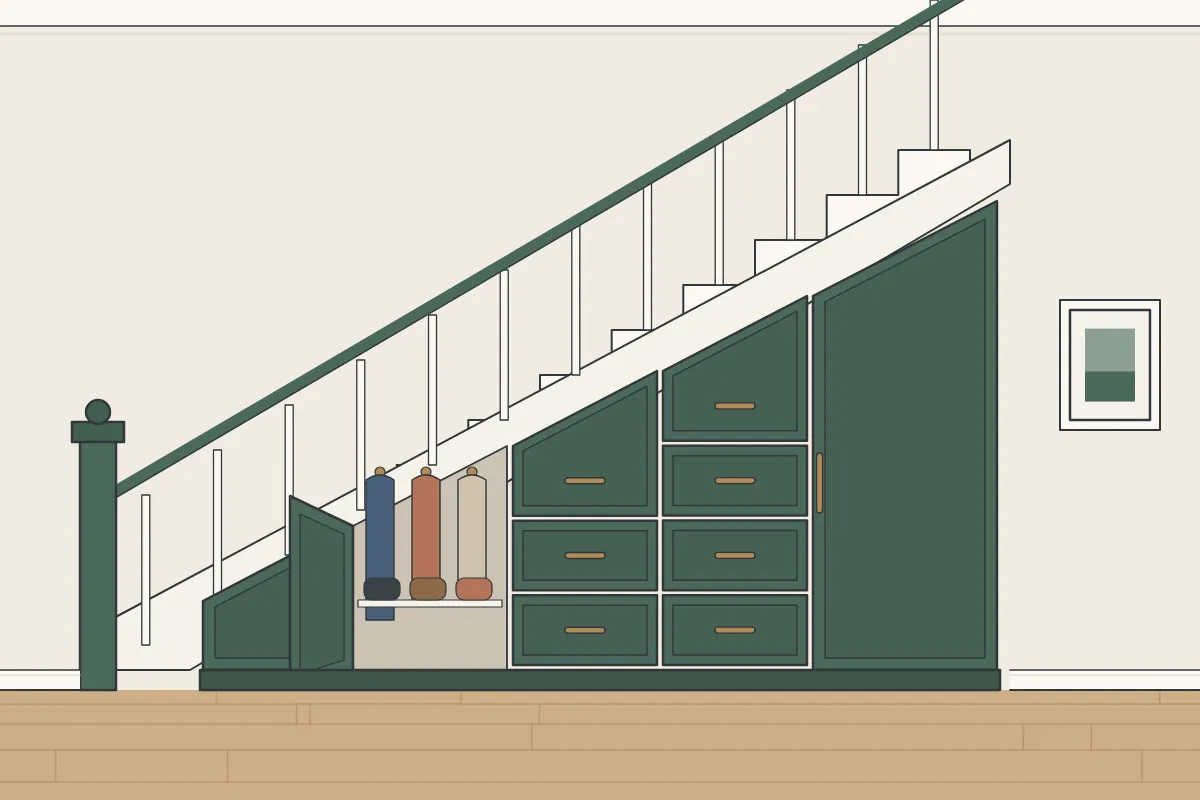
Not every staircase is in a house. Maisonettes, split-level flats and homes with stairs down to a lower floor often have usable space beneath the steps. The parts we make in our workshop are sized to get through the doors and hallways on the way in. Wherever your home is in the City of London, the process is the same. If your home has a dark, wasted space under the stairs and a staircase with untidy space beneath it, under-stairs cupboards made from birch plywood and moisture-resistant MDF with a spray-painted or hand-painted finish can solve it.
Many homes around the City of London date from the post-war decades. Post-war homes normally have squarer rooms and fewer nooks than period ones, which means under-stairs cupboards can add storage that was never built in. Walls may be concrete, block or brick, so fixings are chosen for the wall.
The written quote puts the design visit in writing: the layout and internal fittings, the materials and the finish. If you’d like to change anything, it’s easier before the furniture is made.
- Where
- City of London (EC4V, EC1A, EC2M, EC2Y)
- Borough
- City of London
- Price
- Quoted for your room
- First step
- A design visit: we measure and talk it through
- Where it’s made
- Made in our workshop and fitted on site
- Boards and paint
- MDF and plywood, painted to order
- Fitting days
- Weekdays, and Saturdays by arrangement
- Contact
- Our contact form
- Last updated
- 27 October 2026
Made for the room, or bought in a box?
Off-the-shelf storage comes in the colours the maker offers. Bespoke storage can be painted in the colour you choose, by spray or by hand, so it can match the hall, the stairs or the woodwork. In a flat with stairs or a small lift, large flat-pack units can be hard to get in, whereas fitted furniture is made in sections sized for the way in. The sections are joined once inside.
There’s no price list: each design is priced in writing after we’ve seen the space. A larger piece means more material and more time, so size is the starting point. Doors, drawers, internal fittings and the finish make up most of the rest.
What you get with us
- Saturdays by prior arrangement
- Workshop-made and fitted by us
- Work across the whole of London
- Built around your room
See our comparison of bespoke and off-the-shelf and what to look for in a quote.
Fitting day, step by step
When the fitting is done, we tidy the room and take up the floor coverings. Before we leave, we go over the finished piece together and explain how to look after the paint. The time the fitting takes depends on how much storage you want under the stairs, and the fitting days are agreed in your quote. Post-war blocks often have shared stairwells and lifts, so the furniture comes in sections that fit them. If the building has rules on lift use or working hours, it helps to tell us during the design visit.
- First you let us know about the stairs and what you’d like to store beneath them.
- At the design visit we measure under the stairs and plan the drawers and doors with you, keeping the meters and fuse board easy to reach.
- You receive a written quote for the storage we’ve discussed, for you to read through.
- The drawers, doors and carcasses are made at our workshop. We use moisture-resistant MDF and birch plywood.
- We fit it in your home, scribed to the stairs and the walls. Any meters stay easy to reach.
Getting ready for fitting day
- Move furniture and belongings away from the wall
- Point out meters, boilers and fuse boards near the furniture
- Check the building’s rules for trades and lift bookings
Starting with a design visit
If you already have something in mind, tell us; if not, we can work it out together at the visit. At the design visit, we measure up and talk the design through with you, and the written quote then sets it out. To start, get in touch through our contact form.
Read more
When is bespoke worth it?
It’s worth being honest about cost: off-the-shelf furniture usually costs less up front. Bespoke makes more sense where the room is tricky, the space is valuable or you want the furniture to look built in.
Where bespoke earns its keep is in rooms that aren’t square. In period homes, walls lean, floors slope and the alcoves on each side are often different widths, which leaves standard units with gaps at the sides and top.
Flats, conversions and lettings
Landlords furnishing a let use fitted furniture too. The materials are the same as for any home: moisture-resistant MDF and birch plywood, finished by spray or by hand.
Many London terraces have been converted into flats, and that often means a shared hallway and a tight turn on the stairs. We plan the size of each section around it, after measuring the route at the design visit.
FAQs: under-stairs storage in the City of London
Does a conservation area in or near the City of London affect fitted furniture?
Usually not: conservation area rules mainly cover the outside of buildings, and fitted furniture inside a house does not normally need planning permission. Listed buildings are different, as works inside that affect their character can require listed building consent from the council. The council’s planning or conservation team can tell you if in doubt.
How do you fit under-stairs storage in a flat in the City of London?
We measure the route in as well as the room: the stairs, landings, lift and doors. Under-stairs cupboards are made at our workshop in sections sized to fit that route, then assembled in your flat. It’s useful to check any building rules and your lease before fitting day.
How do I get a quote for under-stairs storage in the City of London?
It’s easiest to use our contact form and let us know about the room. After that, we arrange a design visit and follow it with a written quote.
What do you do at the measuring visit?
It’s a chance to measure properly and talk through what you’d like. We also check the walls and floors and note radiators, sockets and other things in the way, then send a quote in writing.
Can you come on a Saturday?
Yes, we can arrange Saturdays. Just mention it when you contact us.
Is the furniture spray painted or hand painted?
There are two options: a spray finish from the workshop, which is smooth and even, or hand painting, which can be done in your home. Your quote sets out which you have chosen.
Nearby places to the City of London
Other services in the City of London
Fitted storage in the City of London
Homes built between 1945 and 1972 make up about 40% of the housing in the neighbourhood around the City of London, with about 27% built since 2000, going by the Valuation Office Agency’s 2025 council tax figures. We take that into account at the measuring visit, since older and newer walls take different fixings. Near the centre of the City of London, Historic England’s list includes Church of St Lawrence Jewry (Grade I), less than half a mile north, and Church of St Mary Le Bow (Grade I), less than half a mile south-west. Works inside a listed home that affect its character, for example removing original joinery or fixing into it, can require listed building consent from the council. It is worth speaking to the council’s conservation officer before the design is final. TfL’s red routes have strict stopping rules. If you live on or close to a main road in the City of London, let us know at the measuring visit. It lets us plan the stop before fitting day.
Living in a block of flats near London Cannon Street station? Then under-stairs cupboards are made in sections sized for the stairs, landings and lift, so measuring the route matters as much as measuring the room. If you live in a period home close to St Olave Old Jewry, pull-out drawers can reach right to the back of a deep under-stairs space. If you live near St Alphage Garden, under-stairs cupboards can be designed to hold outdoor kit, from walking boots to picnic things.
The City of London is one of London’s 33 local authority areas. Homes in the City of London are part of the area we cover for under-stairs storage. Our work takes in places right across the rest of London, from the busiest high streets to quiet residential roads.
Design visits and fitting in EC4V, EC1A, EC2M and EC2Y work the same way as everywhere else we cover. Whether you live on a street like Aldermanbury Square, Monkwell Square and Paternoster Square or on one nearby, we can visit to measure up for under-stairs storage. The City of London is near the A1 and A3; on busy main roads, unloading under-stairs cupboards takes a little planning. If you are just outside the City of London, we also cover Barbican Estate (1 mile north), Bishopsgate (1 mile east), Finsbury (1 mile north), Aldgate (1 mile east) and St Luke's (1 mile north).
Local landmarks in the City of London
In the City of London, that includes homes near Golden Fleece pub, Prior Weston Primary School and Children's Centre and Barts Health Archives, among other places. The City of London has its own railway station: London Cannon Street station. Other landmarks nearby include Gabriel's Wharf (0.8 miles south-west) and London Mithraeum (less than half a mile south). Not far away are Ludgate Hill.
Boards, parts and paint
Birch plywood
The drawers under a staircase can carry a real load. Birch plywood suits them, as it’s strong and holds screws well. It also suits longer shelves.
Hand-painted finish
Hand painting on site lets the storage be finished alongside the woodwork around it. It’s easy to touch up later. Like any new paint, it needs time to cure fully.