
Westminster · London
City of Westminster Under-Stairs Storage
We make under-stairs storage in moisture-resistant MDF and birch plywood for homes in City of Westminster. Each piece is finished by spray or by hand, in the colour you choose.
- Struggling to reach the gas or electricity meter
- Needing a compact spot for a laptop
- A sloping corner nobody can reach
Need under-stairs storage in City of Westminster?
What we don’t do
Electrics, plumbing, gas, plastering and structural work aren’t part of what we do. Please bear these in mind too:
- Moving gas pipes under the stairs
- Painting the hallway walls and ceiling
- Electrical work under the stairs, which your electrician carries out
If in doubt, you can fill in our short enquiry form and describe the room before you arrange a visit. Our process from visit to fitting.
What it’s made from
- Hand-painted finish
- Coat hooks and shoe shelves
- Moisture-resistant MDF
- Birch plywood
- Pull-out drawers
- Spray-painted finish
Under-stairs storage in City of Westminster: what you get
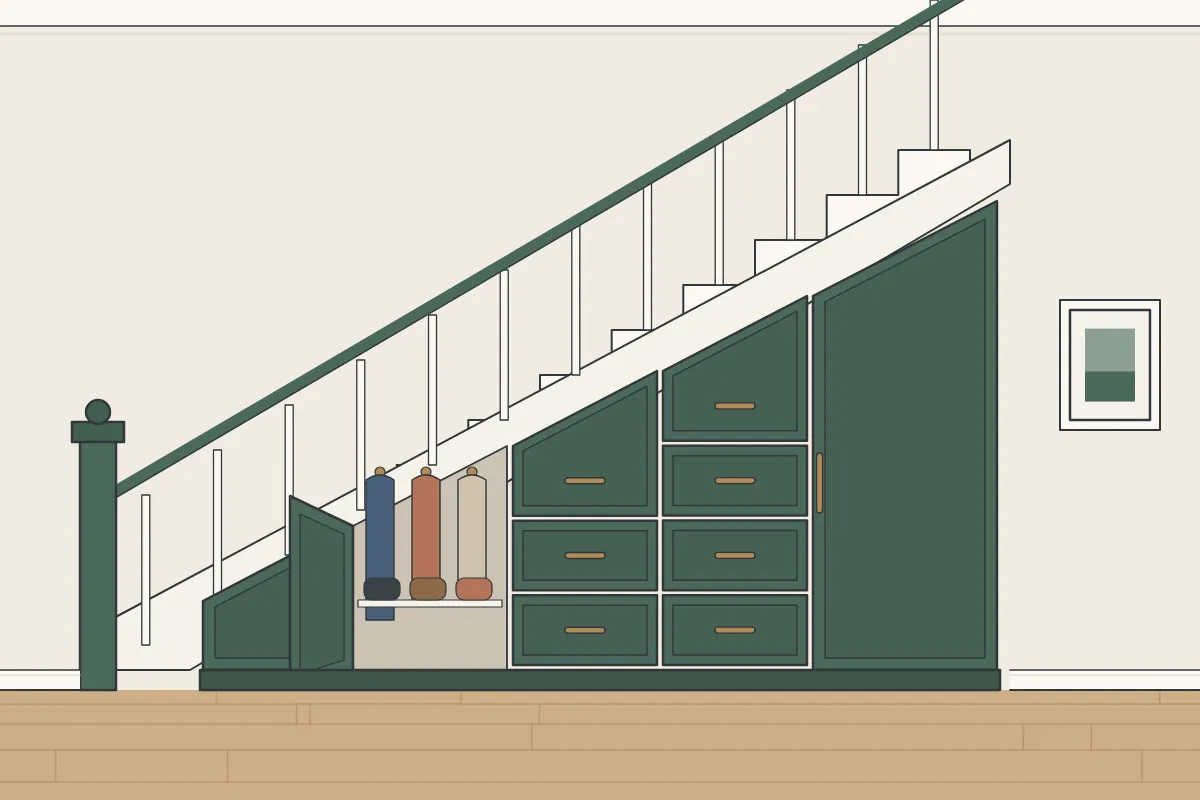
Pull-out drawers make the most of the low, deep end of the space. Rather than reaching into the dark, you pull the drawer towards you and see what’s inside. At the tall end, a cupboard works well for coats, an ironing board or the vacuum. Many designs for homes in City of Westminster combine the two. If your home has wanting a quiet corner for paperwork and an old cupboard door that doesn’t suit the hall, under-stairs cupboards made from moisture-resistant MDF and birch plywood, finished by spray or by hand can solve it.
Ceilings and floors in homes built before 1919 are rarely level, and a large share of the homes around City of Westminster date from then. Under-stairs cupboards are scribed to the walls and levelled on site so doors, lids and drawers run true. Original skirting and mouldings are met neatly, and the paint colour is agreed with you.
The furniture is built in our workshop after you’ve had the quote and decided to go ahead. It describes the design, the materials and the finish agreed at the visit, so every detail can be checked first.
- Where
- City of Westminster (W2, NW8, W9, SW1V)
- Area
- Westminster
- Cost
- Quoted for your room
- First step
- We visit, measure, then quote
- Where it’s made
- Workshop-made, then fitted
- Boards and paint
- MDF and plywood, painted to order
- Working days
- Weekdays (Saturdays if arranged)
- Get in touch
- Our contact form
- Page updated
- 27 October 2026
What happens on fitting day
Every fitting follows the same order: we protect the floors, bring the sections in, set them level, scribe them to the walls, fix them and finish them. At the end, we tidy up and go over the work with you. The time the fitting takes depends on the shape of the space and the number of drawers and doors, and we confirm the fitting days in your quote. Older London houses often have narrow hallways and tight turns on the stairs, so under-stairs cupboards are made in sections sized to get through. Floors, stairs and doorways are covered before anything is carried through, and the sections are joined and scribed in the room.
- You tell us about the space under the stairs.
- At the design visit we measure and plan how you will use the space.
- We send a quote in writing covering the design, materials and finish.
- The storage is made at our workshop from moisture-resistant MDF and birch plywood.
- We fit it in your home with a spray-painted or hand-painted finish, and run through each drawer and door with you.
- New paint needs time to cure fully, so open and close things gently at first.
Preparing the room
- Let us know about any meters, fuse boards or boilers in the area
- Clear the area where the furniture is going
- Clear the hallway and stairs so the sections can come through
Arranging a design visit
Because every job is different, the cost is set out in a written quote after the visit. Because every room is different, the quote comes after the design visit, when we have measured up and talked through the design. To arrange a visit, message us from the contact page.
Related advice
Flat-pack or bespoke?
Where bespoke earns its keep is in rooms that aren’t square. Older London rooms tend to have leaning walls, sloping floors and alcoves of different widths, and standard units leave gaps.
It’s worth being honest about cost: off-the-shelf furniture typically costs less up front. Bespoke makes more sense where the room is awkward, the space is valuable or you want the furniture to look built in.
Under-stairs storage in City of Westminster: local notes
In the neighbourhood around City of Westminster, the largest groups of homes date from before 1919 (about 46%) and the years since 2000 (about 19%), on the Valuation Office Agency’s council tax figures for 2025. The age of a home tells us a lot about its walls, floors and ceilings, and so about how under-stairs cupboards are fixed and fitted. Part of City of Westminster is in the Stratford Place Conservation Area, according to Historic England’s records. Being in a conservation area mainly affects changes to the outside of a building, and fitted furniture inside a house does not normally need planning permission. The council can confirm if you’re not sure. Red routes, run by TfL, have strict rules on stopping and loading. Where a home in City of Westminster is on or beside a main road, it helps to mention that at the measuring visit. We will plan where the van can stop.
Handel Hendrix House, about 0.3 miles east, is one of the historic houses in the wider area. For a period home anywhere nearby, pull-out drawers can reach right to the back of a deep under-stairs space. For an older house near St Mark's, the cupboard door under a period staircase can be kept or replaced to match the new storage.
City of Westminster is within the City of Westminster. City of Westminster is part of the area we cover, and the process is the same everywhere we work. In Westminster, City of Westminster is one of the places we cover.
We make under-stairs storage across the W2, NW8, W9 and SW1V postcode area. You will find streets here such as Portman Square, Grosvenor Square and Cavendish Square, and we cover homes on all of them for under-stairs storage. Main roads around City of Westminster include the A4 and A5, and we plan where the van can stop before fitting day. We also cover Marylebone (1 mile north-east), Mayfair (1 mile south-east), Tyburn (1 mile west), Burlington Estate (1 mile south-east) and Connaught Village (1 mile west). We also make under-stairs storage in nearby places like Aldwych (2 miles east), Clare Market (2 miles east), Westbourne (2 miles west), Westbourne Green (2 miles west), Pimlico (2 miles south) and Maida Vale (2 miles north-west). Being one of the larger places in Westminster, City of Westminster is covered for under-stairs storage and everything else we make.
Landmarks near City of Westminster
The streets we cover here include those near Devonshire Arms, Royal Society of Medicine Library and The St Marylebone CofE School. There is a railway station in City of Westminster itself: Bond Street station. Well-known places in the area include Fortius Clinic (less than half a mile north) and Kingly Court (0.6 miles east). Green spaces nearby include Serpentine.
Places near City of Westminster
Also in City of Westminster
Questions we’re often asked
Can you make under-stairs storage for a home in City of Westminster?
Yes, we work across Westminster, City of Westminster included, and across the rest of London. You can get in touch through our contact form to arrange a design visit.
Will a conservation area stop me having under-stairs storage fitted in City of Westminster?
Usually not: conservation area rules mainly cover the outside of buildings, and fitted furniture inside a house does not normally need planning permission. If your home is listed, works inside that affect its character may need listed building consent, so check with the council first. The council’s planning or conservation team can tell you if in doubt.
Can the fitting be on a Saturday?
Yes, by arrangement. Tell us when you contact us if a Saturday suits you best.
What do you do at the measuring visit?
It’s a chance to measure properly and talk through what you’d like. We also check the walls and floors and note radiators, sockets and other things in the way, and the written quote comes afterwards.
Can you fit a small desk under the stairs?
That depends on the shape of your stairs and the room beside them. At the design visit we will say whether a desk makes sense there. Where it works, it makes a neat spot for a laptop and paperwork.
What if my walls and floors are out of level?
That’s normal in older homes, and it is what scribing is for. We scribe the edges to follow the wall and set the furniture level on adjustable feet or a plinth.
The problems under-stairs storage solve
The low end of the space is typically the problem. You can’t stand up in it, and you cannot reach the back without kneeling. Pull-out drawers solve that by bringing the back of the space to you.
Here’s what under-stairs storage can help with:
- Struggling to reach the gas or electricity meter
- Nowhere to keep the vacuum and ironing board
- Wanting a quiet corner for paperwork
- Storage that does not match the hallway
If your home is as old as some of the listed buildings nearby, such as Church of St Mark's, original features like shutters, panelling and fireplaces are worth designing around. If your own home is listed, check with the council before fixing into original features.
What to check before you book
- Which materials they’ll use, named in the quote
- Whether the finish is set out in the quote
- How they’ll get the furniture into the room
- Have they thought about parking near you?
Before and after fitting day
Getting the most from under-stairs storage starts with the planning and carries on after fitting day. Here are some things worth bearing in mind:
- Measure your vacuum cleaner and ironing board
- Think about handles and how the fronts will look from the hall
- Clear the space before the design visit if you can
- Mention any parking rules on your street
Before we leave, we check every drawer and door with you. Any door to a meter or fuse board is checked so it opens fully and leaves the meter in view. You will know everything works as planned.
Keep sharp or very heavy items away from the painted fronts. Put tools in a case so they don’t knock the paint. A small chip on a hand-painted finish is easy to touch in.