
Kensington and Chelsea · London
Under-stairs storage in Notting Hill, Kensington and Chelsea
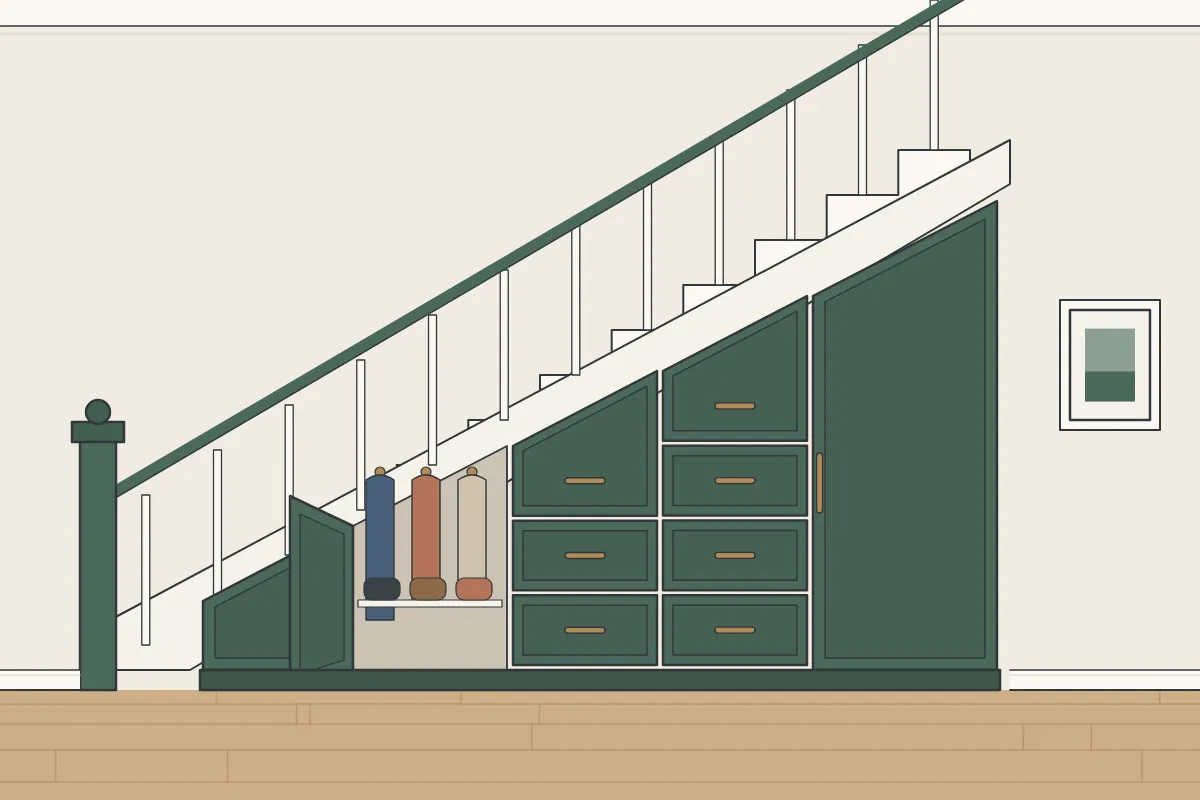
In Notting Hill, we design under-stairs storage around the room you actually have. We design your under-stairs cupboard at a visit to your home, make it in our workshop and fit it.
- Cleaning things with no proper home
- A fuse board that is hard to get to
- An old cupboard door that doesn’t suit the hall
Ask about under-stairs storage in Notting Hill
How fitting works for under-stairs storage
You are welcome to ask questions while we work. Most of the decisions were made during the design visit and set out in your quote, so the day itself is about careful fitting and leaving the room tidy. The time the fitting takes depends on how much storage you want under the stairs, and we confirm the fitting days in your quote. Older London houses often have narrow hallways and tight turns on the stairs, so the furniture comes in sections sized for the route in. Floors, stairs and doorways are covered before anything is carried through.
- You get in touch with some details and, if you like, a sketch. It helps to say whether the meters are under there.
- At the design visit, we look at the stairs, the hall and what you need to store, and check where the meters and fuse board sit.
- Your quote sets out the design, the materials and the finish. Take your time to look through it.
- We make the drawers, doors and carcasses in our workshop. The materials are moisture-resistant MDF and birch plywood.
- The storage is fitted and set level, ready for the first coats and shoes.
Before fitting day
- Move furniture and belongings away from the wall
- Keep pets in another room while we work
- Arrange any electrical changes with your electrician ahead of time
Getting a quote
To make a start, use our contact form and tell us a little about the room. We then arrange a design visit to measure and discuss the design, and send you a written quote afterwards.
Advice
How we make under-stairs storage for Notting Hill
No two staircases are quite the same. The soffit slopes, the stringer sets its own line, and floors are often a little out of level. We scribe the storage to the stairs and the walls, so it looks as though it has always been there. It is the part of the job a boxed unit simply cannot manage. Typical reasons to get in touch are a staircase with untidy space beneath it and a dark, wasted space under the stairs, and the answer is made in our workshop from birch plywood and moisture-resistant MDF with a spray-painted or hand-painted finish.
A Victorian or Edwardian terrace normally has a long, narrow hall leading to the stairs. A large share of the homes around Notting Hill were built before 1919, so every bit of depth is weighed up when storage is planned. Shallow units keep the way through clear.
The written quote puts the design visit in writing: the layout and internal fittings, the materials and the finish. If you’d like to change anything, it is easier before the furniture is made.
- Place
- Notting Hill (W11, W8, W2)
- Area
- Kensington and Chelsea
- Price
- Quoted for your room
- First step
- We visit, measure, then quote
- Where it’s made
- In our workshop, then fitted in your home
- Boards and paint
- MDF and plywood, painted to order
- Fitting days
- Weekdays, and Saturdays by arrangement
- Get in touch
- The contact form
- Updated
- 27 October 2026
FAQs: under-stairs storage in Notting Hill
My house in Notting Hill is Victorian. Can you deal with uneven walls?
Yes, that’s normal in older houses: each piece is scribed to the wall and levelled at the base. We also work around skirting boards, picture rails and cornices. Older walls can be solid brick or lath and plaster, and the fixings are chosen to suit.
Do you make under-stairs storage for homes in Notting Hill?
Yes. We cover all of Kensington and Chelsea and the rest of London, and Notting Hill is part of that. The first step is a design visit, where we measure and talk through the design, and then we send a quote.
Which materials go into your under-stairs cupboards?
Our storage is made from moisture-resistant MDF and birch plywood, then painted. Birch plywood holds screws well, which matters for drawers that carry weight. The materials and finish are agreed in your quote.
Can you fit a small desk under the stairs?
It depends on the height and how open the space is. We look at it during the design visit and tell you honestly whether it will work. If it does, a compact desk with shelving can suit paperwork and a laptop.
What happens at the design visit?
We take full measurements, look at the walls and floors and work through the design together. Access and parking are worth talking about too, and afterwards we send a quote in writing.
Can you fit furniture on an external wall?
It needs a little planning: leaving ventilation behind and inside helps stop condensation. Damp treatment is not something we do, so any damp needs sorting first.
Storage in Notting Hill homes: local notes
In the area around Notting Hill, the largest groups of homes date from before 1919 (about 69%) and between 1973 and 1999 (about 11%), in the VOA’s 2025 council tax stock figures. We take that into account at the measuring visit, since older and newer walls take different fixings. Notting Hill is partly covered by the Ladbroke Conservation Area, one of the conservation areas recorded by Historic England. Conservation area controls are mainly about the outside of buildings, and fitted furniture inside a house doesn’t normally need planning permission. Your council can advise if you are unsure. Parking on many inner London streets is controlled, with zones run by each borough. A van working in Notting Hill will usually need a visitor permit, a paid bay or a bay suspension arranged through the council, which often needs notice. We ask about parking during the design visit, so the van can be planned for.
Close to Holland Park? Living near green space often means muddy boots, bikes and outdoor kit, and under-stairs cupboards can give those things a place. For an older house near St John's Notting Hill, the cupboard door under a period staircase can be kept or replaced to match the new storage. For families living near St Clement and St James CofE Primary School, deep drawers suit the bulky things families collect, from scooters to swimming kit.
Notting Hill is about 1 mile south of Kensington, within the Royal Borough of Kensington and Chelsea. We cover Notting Hill as part of our work across Kensington and Chelsea. In Kensington and Chelsea, Notting Hill is one of the places we cover.
In W11, W8 and W2, the process is the same as anywhere else in London. You will find streets here like Walmer Road, Aubrey Road and Sirdar Road, and homes on each of them are within our area for under-stairs storage. Notting Hill sits close to the A402 and A4204, and we plan where the van can stop before fitting day. We also cover Holland Park (1 mile south), Notting Dale (1 mile north-west), Kensington (1 mile south), Shepherd's Bush (1 mile south-west) and White City (1 mile west). Other parts of Kensington and Chelsea we cover include Brompton (2 miles south-east), Chelsea (2 miles south-east), South Kensington (2 miles south-east), World's End (2 miles south-east) and Little Chelsea (2 miles south-east).
Local landmarks in Notting Hill
We fit furniture in homes around The Sun In Splendour pub, Kensington School and Holland Park School, among other places. Notting Hill’s nearest station is Shepherds Bush station, roughly 0.6 miles south-west of the centre. A little further out are Paddington General Hospital (1 mile north) and Greek Orthodox Cathedral Treasury Museum (0.6 miles east). Open spaces near Notting Hill include Campden Hill and The Long Water.
What we do not do
Damp treatment and building work are for other specialists, and there are a few other limits too:
- Any wiring or new lights, which need an electrician
- Plastering and decorating around the new storage
- Any work on gas pipes or appliances
Not sure whether your space suits under-stairs storage? You can use our contact form and we’ll tell you. Our process from visit to fitting.
What it’s made from
- Coat hooks and shoe shelves
- Moisture-resistant MDF
- Birch plywood
- Pull-out drawers
- Spray-painted finish
- Hand-painted finish
DIY, flat-pack or bespoke
Where bespoke earns its keep is in rooms that are not square. In period homes, walls lean, floors slope and the alcoves on each side are often different widths, and standard units leave gaps.
Cost matters, and it is fair to say so: flat-pack is usually cheaper to buy. Bespoke makes more sense where the room is awkward, the space is valuable or you want the furniture to look built in.
Nearby places to Notting Hill
Other services in Notting Hill
Tips worth knowing
Fresh paintwork takes a while to cure fully, so go gently with it for a while. Beyond that, these tips help:
- Plan decorating around the fitting
- Consider the colour of the hall, the stairs and the skirting
- Note the size of anything tall you want to store
- Look for meters, a fuse board or pipes before we visit
When we’ve finished fitting, the drawers and doors are ready to use. New paintwork takes time to cure fully, so go easy on it to begin with. Avoid sticky tape, heavy knocks and harsh cleaners while it hardens.
Do not store things in front of the meter or fuse board. Readers and engineers need to reach them, and you may need to as well. A dedicated door makes this easy to keep up.
Bespoke under-stairs storage or ready-made?
If you only need a hook or two and a basic shelf, an off-the-shelf option may be enough. Bespoke work earns its place when you want to use the whole space, from the tall end to the lowest corner. At the design visit, we can talk honestly about which approach suits your stairs. Tall standalone furniture needs fixing back to the wall so it can’t tip, and older walls of brick or lath and plaster make that harder than it looks. Fitted furniture is designed with the wall in mind.
Access to the room makes a difference too. Narrow halls, tight stairs or a small lift may mean the furniture is made in more sections, and that is part of the price. Every piece is quoted for your room after the design visit.
Why work with us in Notting Hill
- A spray or hand-painted finish
- Designed for the room you have
- More than 300 projects completed
- Edges scribed to follow your walls
Take a look at bespoke vs off-the-shelf or how to compare quotes.