
Greenwich · London
Woolwich Under-Stairs Storage
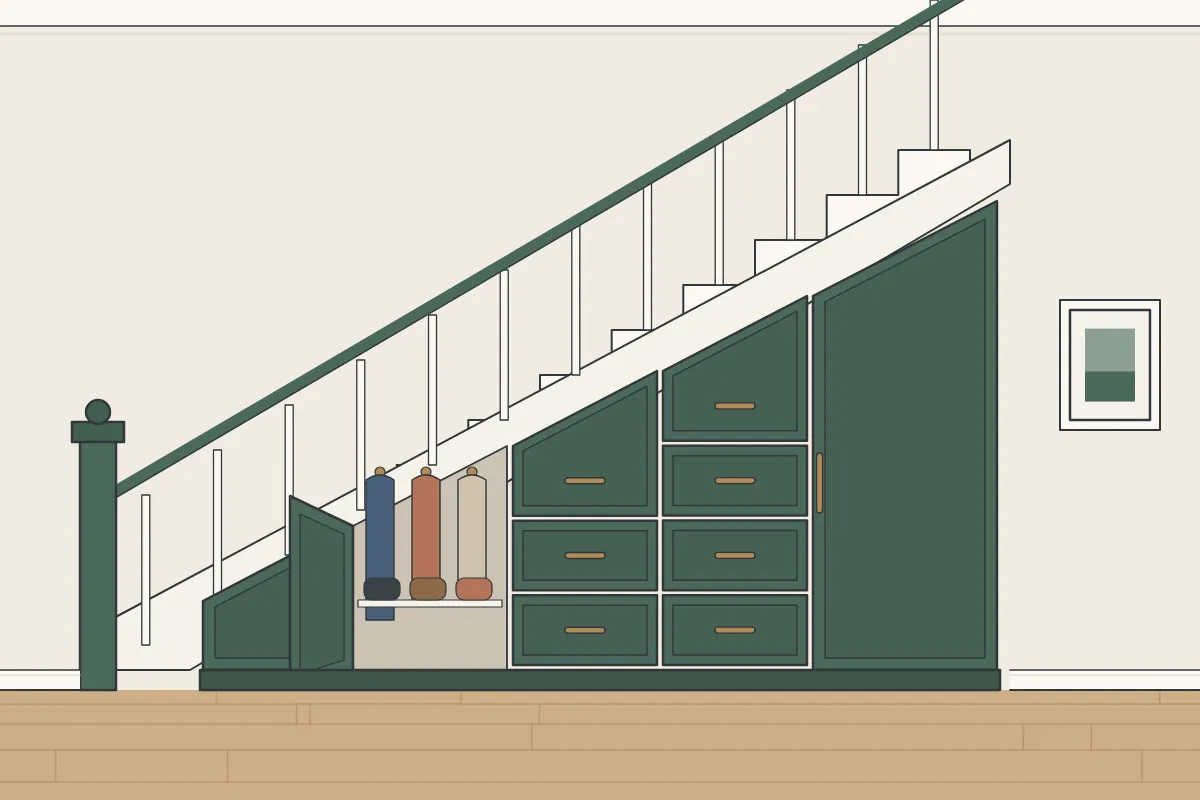
For homes in Woolwich, we make under-stairs storage from moisture-resistant MDF and birch plywood. The finish is spray painted or hand painted, in a colour agreed with you.
- No room for a small desk or a place to work
- A vacuum cleaner that has nowhere to go
- A staircase with untidy space beneath it
Under-stairs storage in Woolwich
How we make under-stairs storage for Woolwich
Each under-stairs cupboard is made at our workshop, using moisture-resistant MDF and birch plywood. Birch plywood is strong and holds screws well, which suits drawer boxes that carry weight, and MDF gives the doors and fronts a smooth surface for paint. The finish is sprayed or hand-painted, and then the storage is fitted in your home in Woolwich. If you’re living with a hallway crowded with coats and shoes and a fuse board that’s hard to get to, that’s what under-stairs cupboards are for, made from birch ply and moisture-resistant MDF, painted by hand or sprayed.
Getting materials into a block means planning the lift, the corridor and the front door of the flat. Around Woolwich, most households are in purpose-built flats, so under-stairs cupboards are drawn in sections from the start. Common parts are protected while the pieces come in.
Materials are named in the quote: moisture-resistant MDF, birch plywood or both, depending on the design. It also says how the furniture will be finished: spray painted or hand painted.
- Location
- Woolwich (SE18, E16, SE7)
- Area
- Greenwich
- Cost
- Quoted for your room
- First step
- A design visit: we measure and talk it through
- Where it’s made
- Workshop-made, then fitted
- Made from
- MDF and plywood, painted to order
- Fitting days
- Weekdays; Saturdays on request
- Enquiries
- Our contact form
- Updated
- 27 October 2026
What it costs
The price for your room depends on:
- How easy it is to get the furniture into the room
- How many doors and drawers there are
- What goes inside: rails, shelves, drawers and dividers
- Parking and unloading on your street
We don’t publish set prices, because every piece is designed for one room. We measure up, discuss the design and send a written quote, with the materials and finish set out. To arrange a design visit, fill in our short enquiry form.
Getting in touch
A little information at the start saves time later. Where you can, include:
- A few photos of the space, taken from the doorway and from each corner
- The postcode, so we can plan the visit
- What kind of home it is, and which floor the room is on
- Radiators, sockets, pipes or meters on or near the wall
If you know what you want, say so; if you don’t, that’s fine, and we can work it out together. The design is talked through at the visit, once we’ve measured, and the written quote that follows sets it out. To start, get in touch through our contact form.
Where other trades come in
Our work is the furniture itself: designing it, making it in our workshop and fitting it. In practice, that means:
- Any wiring or new lights, which need an electrician
- Relocating meters, which your energy supplier deals with
- Structural changes to the staircase itself
If in doubt, you can tell us about the room on our contact form and describe the room. How a job runs, step by step.
What it is made from
- Spray-painted finish
- Hand-painted finish
- Coat hooks and shoe shelves
- Birch plywood
- Pull-out drawers
- Moisture-resistant MDF
Questions we’re often asked
Is Woolwich in the area you cover for under-stairs storage?
Yes, we work across Greenwich, Woolwich included, and across the rest of London. To get started, you can message us from the contact page with some details.
I live in a flat in Woolwich. How will the furniture get up the stairs?
We measure the route in along with the room itself: the stairs, landings, lift and doors. Under-stairs cupboards are built in our workshop in sections sized to fit that route, then assembled in your flat. If your building has rules on lift booking or working hours, or your lease needs consent for alterations, it is worth checking those early.
Should I send pictures?
Yes. They give us a feel for the space before we visit, along with rough sizes. It helps to show radiators, sockets and anything else on the wall.
Do I get to choose the colour?
The choice is yours, and we agree it with you before the furniture is finished. Whichever finish you pick, it is in the colour you have chosen.
How long does the fitting take?
It depends on the shape of the space and the number of drawers and doors, and your quote sets out the fitting days. It is something we discuss at the design visit.
How is the price worked out?
It depends on the size, the number of doors and drawers, the internal fittings and the finish. We send a written quote after the design visit.
Bespoke under-stairs storage or ready-made?
Off-the-shelf storage isn’t designed around a meter or a fuse board. Fitted in front of one, it can make access tricky for readings and safety checks. A design made for the space keeps them in clear reach from the start. Standard furniture does not allow for boxed-in pipes, risers or meter cupboards, leaving gaps or blocking access. Built-in pieces are designed around them, with access kept.
Every piece is quoted for your room after the design visit. Bigger pieces use more board and take longer to make and fit, so size comes first. Doors, drawers, internal fittings and the finish make up most of the rest.
Why choose us
- Built from moisture-resistant MDF and birch plywood
- A design visit, then a quote in writing
- Every London borough and the City of London covered
- Built around your room
Under-stairs storage for homes in Woolwich
About 31% of the homes in the streets around Woolwich went up since 2000, and about 25% between 1973 and 1999, according to Valuation Office Agency council tax figures (2025). That matters for under-stairs cupboards, as the build era decides whether a wall is solid brick, lath and plaster, block or plasterboard. Woolwich is partly covered by a conservation area, going by Historic England’s data. Being in a conservation area mainly affects changes to the outside of a building, and fitted furniture inside a house doesn’t normally need planning permission. Your council can advise if you are unsure. About 61% of households in the area around Woolwich live in purpose-built flats, according to Census 2021. For a flat, under-stairs cupboards are made in sections sized for the stairs, the lift and the doors. Many blocks have rules on lift booking and working hours, so check with the managing agent before fitting day.
If your home is as old as some of the listed buildings nearby, such as Woolwich Town Hall, original features like shutters, panelling and fireplaces are worth designing around. For a listed home, fixing into original features can need listed building consent. Living in a block of flats near Woolwich Dockyard station? Then the lift, the stair turns and the front door all set the largest piece that can come in. The wider area includes historic houses such as Queen's House, about 2.9 miles west. For a period home anywhere nearby, the space under the stairs may hold the meters or the fuse board, and the cupboards are planned around them.
Woolwich is within the Royal Borough of Greenwich, about 1 mile east of Plumstead. From period terraces to newer flats in Woolwich, the furniture is designed around the room as we find it. Woolwich is one of the places in Greenwich where we make under-stairs storage.
Design visits and fitting in SE18, E16 and SE7 work the same way as everywhere else we cover. Whether you live on a street like Market Street, Woolwich High Street and Beresford Square Market Place or on one nearby, we can visit to measure up for under-stairs storage. Other places close to Woolwich include Plumstead (1 mile east), Charlton (1 mile west), New Charlton (1 mile west), Shooter's Hill (1 mile south) and Kidbrooke (2 miles south-west). Across the rest of Greenwich, our area takes in Greenwich (3 miles west), Eltham (3 miles south), Well Hall (2 miles south), Maze Hill (3 miles west), Coldharbour (4 miles south) and New Eltham (4 miles south). Woolwich is among the bigger places we cover in Greenwich.
Near you in Woolwich
The streets we cover here include those near Oasis Academy Silvertown, Oasis Academy Silvertown and The Great Harry pub, among other places. Woolwich has its own railway station: Woolwich Dockyard station. Nearby you’ll also find British Hospital for Mothers and Babies (0.5 miles west) and Gallions Reach Shopping Park (1.6 miles north-east). Not far away are Gilbert's Pit.
How fitting works for under-stairs storage
On the morning of the fitting, we start by protecting your floors and the route from the front door to the room. Next, we carry in the sections made at our workshop, a piece at a time. How long fitting takes depends on the shape of the space and the number of drawers and doors, and the fitting days are agreed in your quote. With little room to spare in a flat, pieces come in as they’re needed. We protect the floors and keep dust to a minimum. The fixings suit each wall, whether solid or stud.
- You tell us about the space under the stairs.
- We come to measure and talk through the design.
- We send a written quote covering the design, materials and finish.
- We make the drawers and cupboards in our workshop from moisture-resistant MDF and birch plywood.
- The storage is fitted and finished, and we check each pull-out with you before we leave.
- Treat the fresh paintwork gently while it cures; a hand-painted finish is easy to touch up later.
Before fitting day
- Book any lift and let the concierge or building manager know
- Arrange any electrical changes with your electrician beforehand
- Clear the walls of pictures and shelves
Getting a quote
The design visit is where every quote starts. We measure the room properly, check how the walls and floors run and go through the design with you. A written quote follows the visit. To book one, fill in our short enquiry form.
Read more
Bespoke or off-the-shelf?
Off-the-shelf furniture can be a sensible choice. If the walls are straight and the space suits standard sizes, it often does the job, and it’s quick to buy.
Bespoke work comes into its own in rooms that aren’t square. Older London rooms tend to have leaning walls, sloping floors and alcoves of different widths, and standard units leave gaps.