
Southwark · London
Under-stairs storage in West Dulwich, Southwark
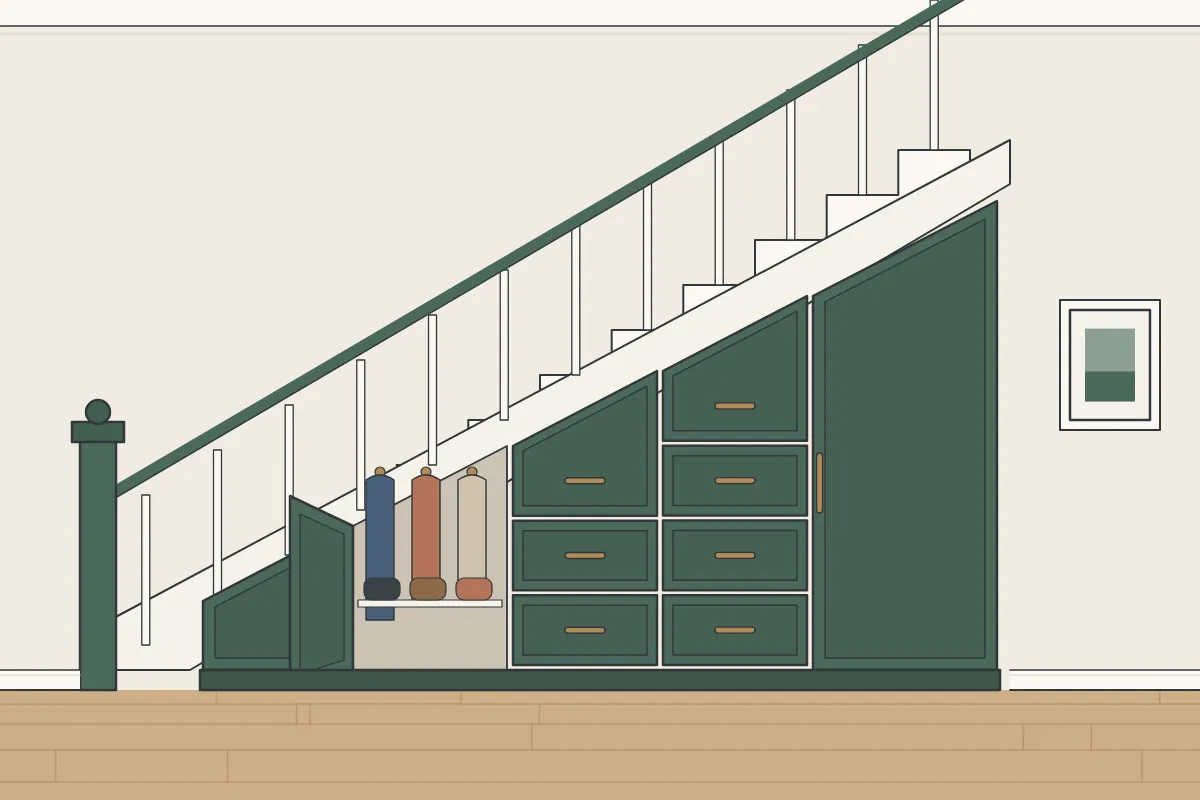
Pull-out drawers, cupboards and coat storage under the stairs, for homes in West Dulwich. After a design visit and a quote in writing, it’s made at our workshop and fitted in your home.
- A meter or fuse board buried behind clutter
- No room for a small desk or a place to work
- A sloping corner nobody can reach
Under-stairs storage for your home in West Dulwich
Storage in West Dulwich homes: local notes
In the neighbourhood around West Dulwich, the largest groups of homes date from between 1945 and 1972 (about 38%) and before 1919 (about 28%), according to Valuation Office Agency council tax figures (2025). For carpentry, the era of a house is a useful clue to how square its rooms are and what its walls are made of. 10 conservation areas have at least part of their area within a mile of central West Dulwich. Historic England says England has around 10,000, and the controls mainly cover the outside of buildings. The ULEZ, run by TfL, takes in all of London, so Southwark is inside it. It applies to every van that comes to fit furniture in West Dulwich. We plan parking and access with you at the measuring visit.
For a flat near Sydenham Hill station, the route in is measured as well as the room, and the sections are sized to fit it. If you live near Long Meadow, under-stairs cupboards can be designed to hold outdoor kit, from walking boots to picnic things. The wider area includes historic houses such as Kingswood House, about 0.2 miles south. If your own home is a period one, under-stairs cupboards are scribed to walls and stair strings that are rarely straight.
West Dulwich is about 2 miles north of East Dulwich, within the London Borough of Southwark. West Dulwich is part of the area we cover, and the process is the same everywhere we work. We cover places right across Southwark, large and small.
Postcode districts we cover here for under-stairs storage: SE21, SE27 and SE19. You will find streets here such as Berry Lane, Clive Road and Myton Road, and homes on each of them are within our area for under-stairs storage. The A2199 runs close to West Dulwich, so if your home is on a main road, mention it when you get in touch. We also cover the places around West Dulwich: Sydenham Hill (1 mile east), West Norwood (1 mile south-west), Gipsy Hill (1 mile south), Dulwich (1 mile north) and Upper Norwood (1 mile south). Other parts of Southwark we cover include East Dulwich (2 miles north), Herne Hill (2 miles north), Bermondsey (4 miles north), Elephant and Castle (4 miles north), Bankside (5 miles north) and Southwark (5 miles north).
Around West Dulwich
Our area takes in the homes around The Wood House and Dulwich Prep & Senior and the streets around them. There is a railway station in West Dulwich itself: Sydenham Hill station. Nearby you will also find St Christopher's Hospice (1.3 miles south-east) and British Vintage Wireless And Television Museum (a few minutes’ walk west). Open spaces near West Dulwich include Dulwich Upper Wood and Knight's Hill.
About our under-stairs storage in West Dulwich
Where a staircase is open to a living space, the storage under it becomes part of the room. That calls for clean lines, well-fitted doors and a finish that suits the rest of the room. We can make plain or panelled fronts, painted to sit with the walls or to stand out. In West Dulwich or anywhere else, the aim is storage that looks considered, not added on. If your home has nowhere to keep the vacuum and ironing board and a hallway crowded with coats and shoes, under-stairs cupboards made from MDF made to resist moisture and birch plywood, then spray-painted or hand-painted can solve it.
Many post-war homes have a boiler in a hall, kitchen or landing cupboard. If it sits in a cupboard you’d like rebuilt, the new storage keeps the clearances and ventilation set out in the manufacturer’s instructions. Because many homes around West Dulwich date from the post-war years, we look for boilers, meters and fuse boards during the design visit. Work on the boiler itself is for a Gas Safe engineer.
The quote comes in writing, so you can read it at your own pace. It records the design, the materials and the finish we discussed.
- Location
- West Dulwich (SE21, SE27, SE19)
- Borough
- Southwark
- Price
- Quoted for your room
- How it starts
- Design visit, then a written quote
- Where it is made
- Made in our workshop and fitted on site
- Made from
- MDF and birch plywood, painted
- Working days
- Weekdays; Saturdays on request
- Contact
- Send us a message
- Page updated
- 27 October 2026
Pricing under-stairs storage in West Dulwich
When we put a quote together, we consider:
- The finish: spray painted or hand painted
- What goes inside: rails, shelves, drawers and dividers
- Access to the room, such as stairs, lifts and narrow halls
- How many doors and drawers there are
The finish affects the cost: spray painting happens in the workshop, and hand painting can be done in your home. The written quote reflects your choice, along with the size and fittings.
Before the design visit
These details help when you get in touch:
- What you’d like to store or use the space for
- Rough sizes, even if they’re only to the nearest few centimetres
- Your postcode and the borough
- A few pictures of the space, taken from the doorway and from each corner
A quote begins with some details from you: the room, rough measurements and some pictures if you have them. To send them, drop us a line using the contact form. We will then arrange a design visit and follow it with a written quote.
Honest limits
Before you plan the job, it helps to know what we don’t do:
- Reshaping or rebuilding the staircase
- Any wiring or new lights, which need an electrician
- Moving gas pipes under the stairs
Not sure whether your space suits under-stairs storage? You can fill in our short enquiry form and we will tell you. How a job runs, step by step.
What it’s made from
- Hand-painted finish
- Pull-out drawers
- Coat hooks and shoe shelves
- Birch plywood
- Spray-painted finish
- Moisture-resistant MDF
Also near West Dulwich
Also in West Dulwich
Questions from West Dulwich
Do I need permission for fitted furniture in a conservation area?
Usually not: conservation area rules mainly cover the outside of buildings, and fitted furniture inside a house doesn’t normally need planning permission. Listed buildings are different, as works inside that affect their character can require listed building consent from the council. The council’s planning or conservation team can tell you if in doubt.
Can you make under-stairs storage for a home in West Dulwich?
Yes, we work across Southwark, West Dulwich included, and across the rest of London. To get started, you can get in touch through our contact form with some details.
Is an outside wall a problem for fitted furniture?
It can be done with some care: leaving ventilation behind and inside helps stop condensation. We do not treat damp, so any damp should be sorted before fitting day.
Do you do the electrics?
No. We are carpenters, so electrical work is for your electrician. We can plan cable routes into the design, and new sockets should be in place before fitting day.
Could the space under my stairs take a desk?
That depends on the shape of your stairs and the room beside them. We look at it at the design visit and tell you honestly whether it will work. If it does, a compact desk with shelving can suit paperwork and a laptop.
Should I choose drawers or cupboards under the stairs?
Often a mix works best. Deep pull-out drawers suit the shallow end under the bottom steps, while a cupboard at the tall end takes coats, the vacuum or an ironing board. We’ll suggest a layout when we visit.
Practical tips
Getting the most from under-stairs storage starts with the planning and carries on after fitting day. These are worth keeping in mind:
- Make room so the whole space can be measured
- Look for meters, a fuse board or pipes before we visit
- Mention any decorating plans so the work can be timed well
- Note the size of anything tall you want to store
When you load the drawers, put the heaviest things low and towards the front. It helps the runners and keeps the storage working well. We size the shelves for what you said you’d store, so it’s worth keeping to that plan.
Every so often, look at the handles and hinges. Tightening a screw early stops a small looseness becoming a problem. If a door drops or a drawer starts to catch, message us from the contact page and let us know what’s happening.
From workshop to your room
The last stage of the day is the finish. With a spray finish from the workshop, there’s usually only filling and touching up to do in the room; hand painting, if that’s what you chose, can be done in place once everything is fitted. The finish is always the one agreed in your quote. Post-war houses tend to have simple halls and stairs, so carrying in is rarely difficult. The way in is still measured, along with the room. The pieces are assembled, levelled and fixed in place.
- You contact us about the space under your stairs.
- We visit to measure the space at several points along the slope, as stairs and walls are rarely square in older houses.
- We send a quote in writing for the storage.
- The drawers, doors and carcasses are built in our workshop from moisture-resistant MDF and birch plywood, cut to the angle of the stairs.
- On fitting day the units are set level and scribed to follow the stairs and walls. The finish is sprayed in the workshop or painted by hand once it is in.
Preparing the room
- Mention any parking restrictions on your street
- Have your electrician move any sockets or switches beforehand
- Point out meters, boilers and fuse boards near the furniture
How to get a quote
We quote each job for the room it’s going into, after the design visit. Because every room is different, the quote comes after the design visit, when we’ve measured up and talked through the design. To arrange a visit, drop us a line using the contact form.
Read more
Boards, parts and paint
Moisture-resistant MDF
We use moisture-resistant MDF because it stays stable and gives a smooth surface for paint. It is used for the doors, fronts and side panels, where a smooth, even finish matters most.
Pull-out drawers
Drawers that pull out make the back of the space easy to use. You see everything at once, without reaching into the dark. They can hold shoes, the vacuum or cleaning things.