
Example photo by Franco Debartolo on Unsplash, not our project
Westminster · London
Window Seats in Chinatown
In Chinatown, we design window seats around the room you actually have. We design your window seat at a visit to your home, make it in our workshop and fit it.
- No space for toys and games
- Looking for a reading spot by the window
- Wanting new furniture to sit well in an older room
Window seats designed for your room
Flats, conversions and lettings
Leaseholders should check the lease before anything is fixed to the walls. Some leases need the building owner’s consent for alterations, and that is best sorted before fitting day. We can’t advise on your lease.
For a rented home, access for the design visit and fitting day has to be agreed with the tenants, at times that suit them. A letting agent can arrange this on a landlord’s behalf.
Window seats for homes in Chinatown
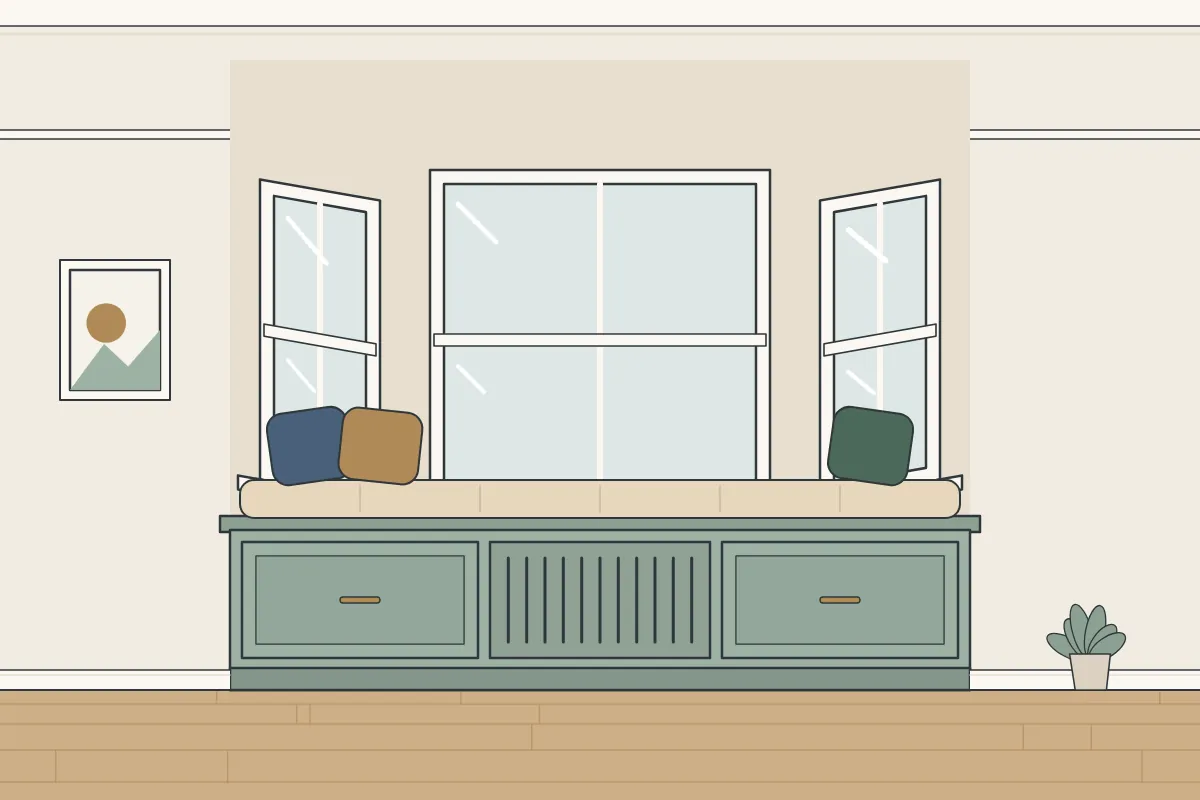
Sash windows are a feature of many older London homes. Under a sash, the seat is set below the cill so the window can still be used. If the window has shutters, the seat is planned so they can still open fully. We check all of this at the measuring visit in Chinatown. We make window seats from birch ply and moisture-resistant MDF, painted by hand or sprayed, and the usual reasons to get in touch are unused space below a sash window and standard furniture leaving gaps in a bay.
Where original shutters, doors or panelling survive, they’re worth designing around. With a large share of the homes around Chinatown built before 1919, fitted storage can be designed to sit alongside them. Door styles can be chosen to suit the age of the house, and painted to match. If your home is listed, check with the council before fixing into original joinery.
The furniture is made at our workshop after you have had the quote and decided to go ahead. The quote sets out the agreed design, materials and finish, so every detail can be checked first.
- Location
- Chinatown (W1F, W1D, W1T)
- Borough
- Westminster
- Cost
- Quoted for your room
- To begin
- A design visit: we measure and talk it through
- Where it’s made
- In our workshop, then fitted in your home
- Boards and paint
- MDF and birch plywood, painted
- When we fit
- Weekdays; Saturdays on request
- Enquiries
- Send us a message
- Page updated
- 27 October 2026
When you need someone else
We design, make and fit the furniture. That means:
- Electrical work around the seat
- Work on the window frame or glass
- Moving or replacing a radiator, which is for your plumber
If in doubt, you can use our contact form and describe the room before you arrange a visit. Our process from visit to fitting.
What goes into it
- Spray-painted finish
- Hand-painted finish
- Radiator grilles
- Moisture-resistant MDF
- Lift-up lids or drawers
- Birch plywood
How fitting works for window seats
Furniture made in a workshop still has to meet the room it’s going into, and fitting day is where that happens. Walls in older homes are rarely flat or square, so we scribe the edges by hand to follow the wall. How long the fitting itself takes depends on the size of the window and the design, and the fitting days are agreed in your quote. Where a period house has been split into flats, the way in often goes through shared parts, so it’s useful to let neighbours know about fitting day. The sections are sized for the narrowest point on the route. Saturday fitting is possible by prior arrangement.
- You get in touch about a window seat.
- We visit to measure and go through the design, the storage and the finish.
- You receive a written quote for the design, materials and finish.
- We build the seat in our workshop from moisture-resistant MDF and birch plywood, ready for the finish you chose.
- We fit it in your home, and a hand-painted finish is applied in the room.
- Fresh paint takes a while to cure, so go gently with the seat and lids at first.
Getting ready for fitting day
- Keep pets in another room while we work
- Take down pictures, mirrors and shelves from the wall
- Clear the area where the furniture is going
Ask for a quote
Photos help us understand the room before we visit. A few pictures showing the walls, the corners and where the ceiling meets them give us a good feel for the space, along with rough sizes. To send them over, tell us about the room on our contact form, and we will arrange a design visit.
Related advice
DIY, flat-pack or bespoke
Where bespoke earns its keep is in rooms that aren’t square. Older London rooms tend to have leaning walls, sloping floors and alcoves of different widths.
If you are handy, a simple shelf or a standard wardrobe in a square room is a reasonable DIY job. It gets harder with sloping ceilings, out-of-level floors and lath-and-plaster walls, because scribing and the right fixings start to matter.
Also near Chinatown
Also in Chinatown
Boards, parts and paint
Lift-up lids
A lid can run the full width of the seat or be split into sections. Sections are lighter to lift and easier to handle. The design visit is where we agree the layout.
Spray-painted finish
Spray painting gives the seat a very even surface. We apply it in our workshop, so treat it gently while it cures fully.
Chinatown homes and window seats
In the neighbourhood around Chinatown, the largest groups of homes date from before 1919 (about 50%) and the years since 2000 (about 23%), based on the Valuation Office Agency’s 2025 council tax data. It’s a good starting point, though every room is still measured, as two homes of the same age rarely match. There are 996 entries on the National Heritage List within half a mile of the centre of Chinatown. Older homes nearby may have original joinery, shutters or panelling worth keeping, and window seats can be designed to work around them. Streets close to central London are often narrow and busy, with loading bays in short supply, so the route from the van to your door is planned ahead of time.
For families living near Soho Parish CofE Primary School, a place for each person’s coat and shoes stops the hallway filling up. If you live in a period home close to St Anne's Church, window seats can be scribed to follow a bay that’s rarely square. Close to St Anne's Churchyard? Window seats can be designed to hold outdoor kit, from walking boots to picnic things.
Chinatown is about 1 mile west of City of Westminster, within the City of Westminster. We work across all London boroughs and the City of London, and Chinatown is part of that. We cover places right across Westminster, from the busiest high streets to quiet residential roads.
Every address in W1F, W1D and W1T is covered for window seats, from the main roads to the quieter streets. We cover homes on streets such as Duck Lane, Drury Lane and Bruton Lane, whether you want window seats or another piece made for the room. Chinatown is near the A4 and A301; on busy main roads, unloading window seats takes a little planning. We also cover Soho (1 mile north), St James's (1 mile south), West End (1 mile north-east), Seven Dials (1 mile north-east) and St Giles (1 mile north-east). Other parts of Westminster we cover include Paddington Green (2 miles west), Paddington (2 miles west), Lisson Grove (2 miles north-west), Westbourne (3 miles west), Little Venice (2 miles west) and Westbourne Green (3 miles west). As one of the bigger places in Westminster, Chinatown is covered for all of our fitted furniture.
Local landmarks in Chinatown
In Chinatown, that includes homes near LITE Regal International School, Harris Westminster Sixth Form and Waxy O'Connor's pub, among other places. There’s a railway station in Chinatown itself: Tottenham Court Road station. Well-known places in the area include Leverian collection (within half a mile south-east) and Kingly Court (within half a mile west). Green spaces nearby include St. James's Park Lake and Ludgate Hill.
Questions from Chinatown
Will a conservation area stop me having window seats fitted in Chinatown?
Not normally. Conservation area controls are mainly about the outside of buildings, so fitted furniture inside a house doesn’t normally need planning permission. If your home is listed, internal works that affect its character can require listed building consent, so check with the council first. If you are unsure, the council can confirm.
My home in Chinatown is a period house with walls that are not straight. Is that a problem?
Yes, that is normal in older houses: each piece is scribed to the wall and levelled at the base. Skirting, picture rails and cornices are met neatly or cut around. Older walls can be solid brick or lath and plaster, and the fixings are chosen to suit.
Is it possible to have a window seat above a radiator?
Yes. We build a grille or an open front into the seat so the heat isn’t trapped. Space is left around the radiator too. If you want the radiator moved, that’s work for your plumber.
Which materials go into your window seats?
Moisture-resistant MDF and birch plywood, with a spray-painted or hand-painted finish. A moisture-resistant grade suits a spot by a window, where condensation can form. Your quote confirms the materials and finish.
How long does it take to fit a window seat?
How long the fitting takes depends on the size of the window and the design, and your quote sets out the fitting days. We make the seat in our workshop, so the time at your home is spent fitting. Saturday fitting is possible by arrangement.
What happens at the design visit?
It’s a chance to measure properly and talk through what you’d like. We also check the walls and floors and note radiators, sockets and other things in the way, then send a written quote.