
Southwark · London
Newington Butts Wall Beds
Wall beds in Newington Butts: fold-down wall beds built into fitted cabinets. We visit to measure and discuss the design, make the furniture in our workshop and fit it.
- A bed that fills a little-used room
- A study that doubles as a spare room
- A storage wall with a bed inside
Wall beds for your home in Newington Butts
About our wall beds in Newington Butts
The bed mechanism must be fixed securely, exactly as its maker specifies, into a wall or floor that’s sound enough to hold it. We check the wall and floor at the design visit, because the fixing has to suit what the wall is made of. If your home has a home office that also sleeps guests and more floor space in a studio flat, wall beds made from moisture-resistant MDF and strong birch plywood, with a painted finish can solve it.
Bedrooms in homes built since 2000 sometimes have big windows that take up much of a wall, so the remaining walls have to work harder. That’s worth planning for around Newington Butts, where many homes date from 2000 onwards, and fitted furniture can use every part of the solid walls. Corner sections are planned so nothing is wasted.
A quote in writing follows the design visit. It sets out the design we have talked through, the materials and the finish, so it is clear what’s included.
- Place
- Newington Butts (SE1, SE17, SE11)
- Borough
- Southwark
- Price
- Quoted for your room
- How it starts
- Design visit, then a written quote
- Where it is made
- Made in our workshop and fitted on site
- Boards and paint
- MDF and plywood, painted to order
- Fitting days
- Monday to Friday; Saturdays by prior arrangement
- Contact
- Send us a message
- Last updated
- 27 October 2026
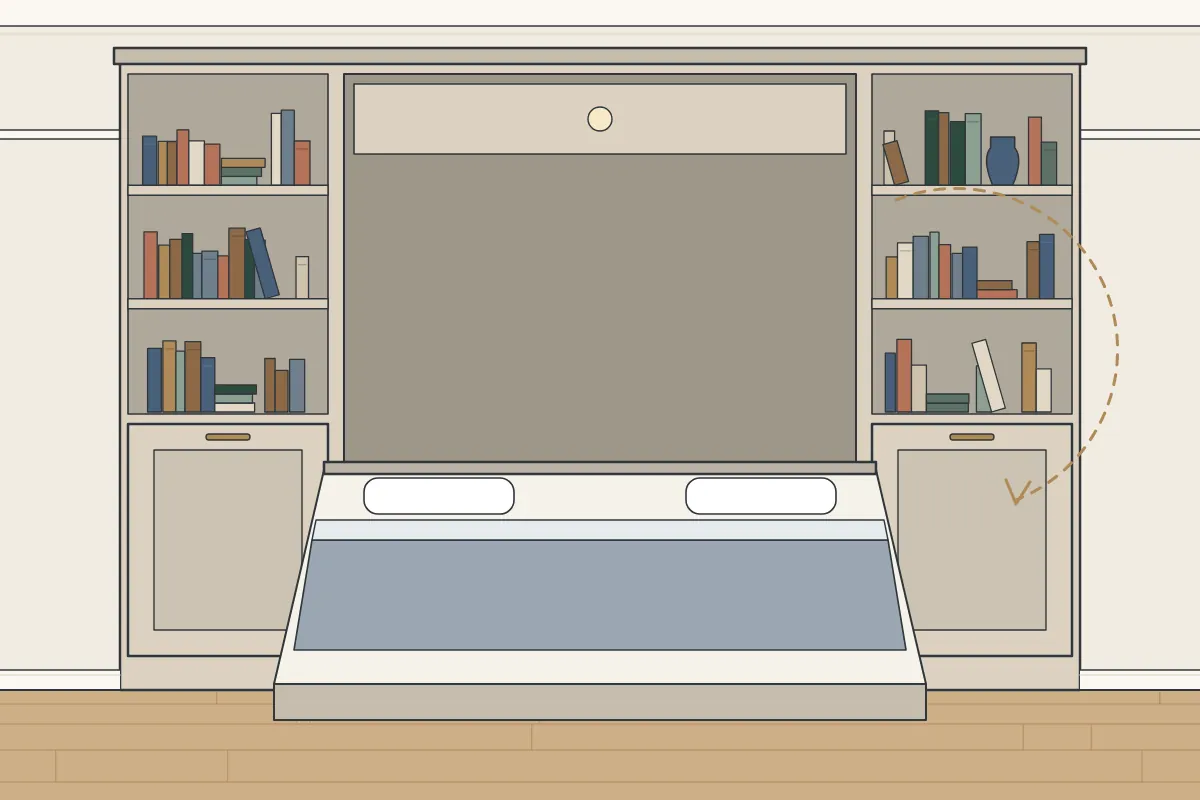
What happens on fitting day
Getting everything level comes first. Where the floor slopes, we bring the furniture up to level on adjustable feet or a plinth, and that keeps the doors and shelves true. After that, it is fixed to the wall using fixings that suit the wall, whether that’s solid brick, lath and plaster or plasterboard. Newer homes often have stud walls, so on fitting day heavy pieces go into the studs or stand on the floor. Floors are covered while we work.
- To begin, use our contact form; a brief note on the room and how often guests stay is plenty.
- At the design visit we check what the wall is made of, as a wall bed has to be fixed securely as its maker specifies.
- You receive a quote in writing for the wall bed and any storage.
- The bed housing and any shelves or desk are built in our workshop from moisture-resistant MDF and birch plywood.
- We fit the cabinet in your home and fix the mechanism as its maker specifies.
- Before we leave we show you how to lower and lift the bed.
Preparing the room
- Move furniture and belongings away from the wall
- Check the building’s rules for trades and lift bookings
- Point out meters, boilers and fuse boards near the furniture
Starting with a design visit
It is useful to see the room before we come. A few pictures showing the walls, the corners and where the ceiling meets them tell us a lot about the space, particularly with rough measurements. To send them over, fill in our short enquiry form, and we will arrange a design visit.
Read more
Places near Newington Butts
What else we make in Newington Butts
Flat-pack or bespoke?
What you pay for with bespoke is mainly the fit: edges scribed to the wall, a level base on a sloping floor and a neat line where the furniture meets the ceiling. In an older room, standard units rarely manage that.
Where bespoke earns its keep is in rooms that aren’t square. In period homes, walls lean, floors slope and the alcoves on each side are often different widths, and standard units leave gaps.
Tips worth knowing
Because fitted furniture stays put, a little upkeep goes a long way. Here are a few tips worth knowing:
- Leaseholders: check your lease first
- Consider how many people will sleep in it
- Give the paint time to cure fully
- Choose a mattress that suits the mechanism
Follow the mechanism maker’s guidance each time you lower and lift the bed. Lower it steadily and keep the space in front clear, and do not let children play with it.
Think about the route into the room. We make the cabinet in sections that fit up the stairs and through the doors, so it helps to know about tight turns.
Flats, conversions and lettings
Many London terraces have been converted into flats, and that often means a shared hallway and a tight turn on the stairs. Each section is sized with that in mind, once we’ve measured the way in.
If your building is on a red route or a busy main road, getting the furniture from the van to the door needs planning. TfL runs the red routes, and the stopping rules are strict, so let us know about it at the measuring visit.
Wall beds for homes in Newington Butts
In the neighbourhood around Newington Butts, the largest groups of homes date from the years since 2000 (about 38%) and between 1945 and 1972 (about 20%), according to Valuation Office Agency council tax figures (2025). It’s a good starting point, though every room is still measured, as two homes of the same age rarely match. There are 131 entries on the National Heritage List within half a mile of the centre of Newington Butts. Original fireplaces, shutters and panelling are worth keeping where they survive, and the furniture can be designed around them rather than over them. TfL’s red routes have strict stopping rules. Where a home in Newington Butts is on or beside a main road, it helps to mention that during the design visit. That way we can plan where to load and unload.
If your home is as old as some of the listed buildings nearby, such as Church of St Peter, original features like shutters, panelling and fireplaces are worth designing around. If your own home is listed, check with the council before fixing into original features. If your children go to London College of Communication or a school nearby, a mix of drawers and shelves copes with school uniform as well as everything else. Benjamin Franklin House, about 1.4 miles north-west, is one of the historic houses in the wider area. If your own home is a period one, solid external walls can be cold, so ventilation behind wall beds is part of the design.
Newington Butts is about 2 miles south of East Dulwich, part of the London Borough of Southwark. Wherever you are in Newington Butts, the process is the same: a design visit, a quote in writing, furniture made in our workshop and fitting in your home. We list Newington Butts among 21 places we cover in Southwark.
We make wall beds across SE1, SE17 and SE11 for wall beds. You’ll find streets here like Dante Road, Oakey Lane and Ash Avenue, and we cover homes on all of them for wall beds. Main roads around Newington Butts include the A302 and A3202. If your home is on one of them, tell us at the measuring visit, as some main roads have strict stopping rules. We also cover the places around Newington Butts: Elephant and Castle (1 mile north), St George's Fields (1 mile north-west), Vauxhall (1 mile west), Lambeth (1 mile west) and Kennington (1 mile south-west). Other parts of Southwark we cover include East Dulwich (2 miles south), Herne Hill (3 miles south), Peckham (2 miles south-east), Rotherhithe (3 miles east), Surrey Quays (2 miles east) and Denmark Hill (2 miles south).
Around Newington Butts
In Newington Butts, that includes homes near Elephant and Castle pub, Notre Dame Roman Catholic Girls' School and Lambeth Palace Library and the streets around them. Newington Butts has its own railway station: Elephant & Castle station. Well-known places in the area include Gabriel's Wharf (1.1 miles north) and Newport Street Gallery (0.7 miles west). Green spaces nearby include Ludgate Hill.
Pricing wall beds in Newington Butts
Every room is different, so every job is quoted on its own. These are the things that affect it:
- Access to the room, such as stairs, lifts and narrow halls
- The width and height of the space
- How square the room is
- How many doors and drawers there are
In London, parking can affect the price. The boroughs run controlled parking zones across much of the city, so we may need a visitor permit, a paid bay or a suspended bay near your home. Let us know about parking at the design visit, so it can be planned.
What to send when you get in touch
The more you can tell us at the start, the better the design visit goes. It’s useful to include:
- Approximate measurements of the space
- What the furniture needs to hold
- Any ideas or images you’ve saved
- Where you live, with the postcode
If you already have something in mind, tell us; if not, we can work it out together at the visit. At the design visit, we measure up and talk the design through with you, and the written quote then sets it out. To arrange a visit, use our contact form.
Questions we are often asked
Is Newington Butts in the area you cover for wall beds?
Yes. Newington Butts is one of the places we work, along with the rest of Southwark and London. You can tell us about the room on our contact form to arrange a design visit.
How do you fit wall beds in a flat in Newington Butts?
At the design visit, we measure the way in as well as the room. The furniture is made in sections that fit the stairs and lift, and put together in the room. It helps to check any building rules and your lease before fitting day.
Can you come on a Saturday?
Yes, we can arrange Saturdays. Let us know when you first get in touch, and we will see what we can do.
What does a wall bed cost?
We quote each job for the room it’s going into, after the design visit. A single bed cabinet and a full wall with shelves and a desk are very different jobs, so we price it after measuring. To arrange a visit, drop us a line using the contact form.
How is the furniture painted?
There are two options: spray painting, done in the workshop for a smooth, even finish, or hand painting, which can be done on site. The finish is agreed in your quote.
Do I need planning permission for fitted furniture?
Not normally. Conservation area controls are mainly about the outside of buildings, and fitted furniture inside a house does not normally need planning permission. Listed buildings are different: check with the council’s conservation officer first.