
Newham · London
Under-Stairs Storage in Wallend
Few London rooms are perfectly square, and we scribe the furniture to follow the walls. Our work on under-stairs storage in Wallend starts with a design visit, and everything is made at our workshop.
- The low end of the space going to waste
- Wanting a quiet corner for paperwork
- A fuse board that’s hard to get to
Need under-stairs storage in Wallend?
When is bespoke worth it?
Where bespoke earns its keep is in rooms that are not square. In period homes, walls lean, floors slope and the alcoves on each side are often different widths.
Off-the-shelf cupboards come in fixed sizes, so there is typically a gap left over at the top or at one end. Furniture we make is built to the room’s own sizes, so it can run to the ceiling and fill the width.
About our under-stairs storage in Wallend
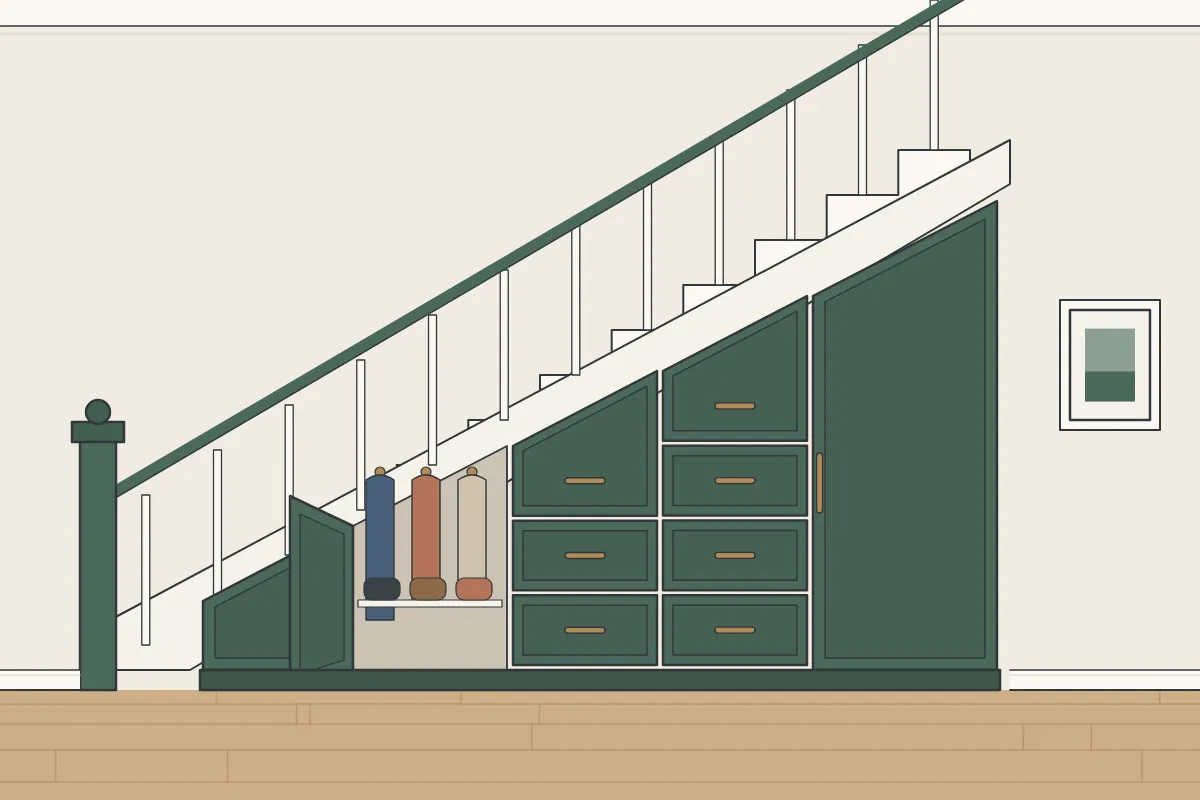
Deep pull-out drawers bring the back of the space within reach. Rather than reaching into the dark, you pull the drawer towards you and see what’s inside. At the tall end, a cupboard works well for coats, an ironing board or the vacuum. Many designs for homes in Wallend combine the two. Typical reasons to get in touch are the low end of the space going to waste and a hallway crowded with coats and shoes, and the answer is built in our workshop from moisture-resistant MDF and birch plywood, spray-painted or hand-painted.
Whether your home in Wallend is a period house, an interwar semi, a post-war flat or a newer build, there is often a corner or recess not doing much. That space can take fitted storage, laid out for what you need to keep. Walls could be brick, lath and plaster, block or plasterboard, so we check before choosing fixings.
The quote comes in writing, so you can read it at your own pace and talk it over at home. It covers the design, materials and finish agreed at the visit.
- Where
- Wallend (E6, IG11, E12)
- Borough
- Newham
- Cost
- Quoted for your room
- How it starts
- We visit, measure, then quote
- Made
- Made in our workshop and fitted on site
- Made from
- MDF and plywood, painted to order
- Fitting days
- Weekdays, and Saturdays by arrangement
- Get in touch
- Our contact form
- Updated
- 27 October 2026
Questions we are often asked
Do you cover homes near Barking station?
Yes, homes across Newham and the rest of London are within the area we cover. To get started, you can use our contact form with a few details about the room.
Can you make under-stairs storage for a home in Wallend?
Yes. Wallend is one of the places we work, along with the rest of Newham and London. You can tell us about the room on our contact form to arrange a design visit.
What materials do you use for under-stairs storage?
Our storage is made from moisture-resistant MDF and birch plywood, then painted. Drawer boxes are birch plywood, as it is strong and holds screws firmly. Your quote confirms the materials and finish.
Should I choose drawers or cupboards under the stairs?
The answer depends on your stairs and what you will keep there. Pull-out drawers suit the low, deep end, as they bring the back within reach. At the tall end, a cupboard is often better for coats and the vacuum.
Can you fit furniture to uneven walls?
Walls and floors that aren’t true are part of the job in older homes. The furniture is scribed to follow the walls and levelled on feet or a plinth.
Can under-stairs storage work around the fuse board?
Yes. We plan the storage so the meter or fuse board stays easy to reach, usually behind its own door. Meter readers and engineers need access, so we never box them in.
Neighbourhoods near Wallend
More for homes in Wallend
Looking after your furniture
Fresh paintwork takes a while to cure fully, so go gently with it for a while. After that, a few simple habits help:
- Note the size of anything tall you want to store
- Consider the colour of the hall, the stairs and the skirting
- Make a list of what you want to store before the design visit
- Let us know if the hall is being decorated
Wiping the fronts with a soft, damp cloth is normally all they need. Dry them afterwards, and avoid abrasive pads and strong solvents. The edges of drawers and the areas around handles pick up marks first.
Keep sharp or very heavy items away from the painted fronts. Store tools in a box or bag, not loose against the doors. Minor chips can be touched up with the matching colour.
What affects the cost of under-stairs storage
The price for your room depends on:
- Stairs, lifts and the route to the room
- Hanging rails, shelves, drawers and other fittings inside
- Awkward walls, sloping ceilings and uneven floors
- How many doors and drawers there are
There’s no price list, because each job is designed for a single room. We measure up, discuss the design and send a quote in writing, naming the materials and finish. To arrange a design visit, fill in our short enquiry form.
What we need to know
What helps most when you first contact us:
- The postcode, so we can plan the visit
- Anything in the way, like radiators, sockets, switches, a boiler or meters
- Examples of the look you’re after
- What you’d like to store or use the space for
If you already have something in mind, tell us; if you do not, that is fine, and we can work it out together. The design is talked through at the visit, once we’ve measured, and the written quote then sets it out. To arrange a visit, message us from the contact page.
Under-stairs storage in Wallend: local notes
Homes built before 1919 make up about 34% of the housing in the streets around Wallend, with about 34% built since 2000, based on the Valuation Office Agency’s 2025 council tax data. Knowing roughly when a home was built helps, because walls and fixings change from one era to the next. Within a mile of the centre of Wallend, 3 conservation areas are recorded by Historic England. Historic England says England has around 10,000, and the controls mainly cover the outside of buildings. Terraced houses are home to about 33% of households in the area around Wallend, based on Census 2021. In a terraced house, the space under the stairs often holds the meters or the fuse board, and they must stay accessible.
For families living near Nelson Primary School, under-stairs cupboards can be planned around what a family needs to keep, from coats and bags to sports kit. If your home is as old as some of the listed buildings nearby, like Parish Church of St Margaret, original features like shutters, panelling and fireplaces are worth designing around. If your own home is listed, check with the council before fixing into original features. If your home is one of the older houses near St John the Baptist's Church, the cupboard door under a period staircase can be kept or replaced to match the new storage.
Wallend is in the London Borough of Newham, about 2 miles west of Plaistow. We can visit homes in Wallend on weekdays, or on a Saturday by arrangement. Wallend is one of the places in Newham where we make under-stairs storage.
Design visits and fitting in E6, IG11 and E12 work the same way as everywhere else we cover. Streets in the area include Hall Road, Quay Road and Ascot Road, and we cover homes on all of them for under-stairs storage. Wallend sits close to the A117, and we plan where the van can stop before fitting day. Neighbouring places we cover for under-stairs storage include East Ham (1 mile south-west), Plashet (1 mile north-west), Upton Park (1 mile west), Manor Park (1 mile north) and Beckton (1 mile south). We also make under-stairs storage in nearby places like Plaistow (2 miles west), Stratford (3 miles west), Canning Town (2 miles south-west), Forest Gate (2 miles north-west), Greengate (2 miles west) and Maryland (3 miles west).
What’s near Wallend
Around Wallend, we cover homes near Dukes Head Public House, Tyndale Academy and Langdon School. The nearest railway station is Barking station, about 0.9 miles north-east of the centre. Nearby you’ll also find Newham University Hospital (1.4 miles south-west) and The Who Shop Museum (within half a mile west).
How fitting day works
On the morning of the fitting, the first job is covering the floors and protecting the way in from the front door. The sections made at our workshop come in next, one at a time. How long the fitting takes depends on how much storage you want under the stairs, and we confirm the fitting days in your quote. On fitting day, the sections are assembled, scribed to the walls and levelled. The fixings suit whatever the walls are made of. Saturday fitting is possible by prior arrangement.
- To begin, send us a few details through our contact form; a brief note on the space and what it holds now is plenty.
- At the design visit we measure the space and plan the storage around the meters, so readers and engineers can still reach them.
- A written quote follows, setting out the design, materials and finish.
- The storage is built in our workshop from moisture-resistant MDF and birch plywood, with access to the meters planned in.
- The storage is fitted and set level, and the meter access is checked with you.
Getting ready for fitting day
- Let us know if your street is in a controlled parking zone
- Check the building’s rules for trades and lift bookings
- Clear the hallway and stairs so the sections can come through
Arranging a design visit
Getting a quote starts with some details: which room it is, rough measurements and a couple of pictures if you can take them. When you are ready, send us a few details through our contact form. After that, we arrange a visit to measure and discuss the design, then send a quote in writing.
Related advice
Flats, leases and landlords
Mansion blocks and purpose-built blocks often have house rules about lifts, entry systems and when trades can come in. Let us know about them at the measuring visit.
Many London terraces have been converted into flats, which often brings a shared hall and tight turns on the stairs. We plan the size of each section around it, after measuring the route at the design visit.