
Westminster · London
Fitted Cupboards in Chinatown
Planning fitted cupboards for a home in Chinatown? It starts with a design visit to measure and talk through ideas, then a written quote, before anything is made.
- Floor-to-ceiling storage in a flat
- Landing shelves for bedding and towels
- A cupboard for a recess or odd corner
Fitted cupboards in Chinatown
Fitted cupboards for homes in Chinatown
Utility rooms and boot rooms need storage that copes with everyday wear. We can build tall cupboards for the vacuum, ironing board and mop, with housing for a washing machine or tumble dryer where you want it. Plumbing is for your plumber and new sockets for your electrician, and we leave room for their work in the design. People typically come to us about floor-to-ceiling storage in a flat and a cupboard for the meters with easy access; the furniture is made from moisture-resistant MDF and birch plywood, spray-painted or hand-painted.
Outside walls in houses from before 1919 are normally solid brick, which can be cold, so a gap and ventilation behind fitted storage help avoid condensation. That matters around Chinatown, where a large share of the homes are that old. Damp should be sorted before anything is fitted against the wall.
A quote in writing follows the design visit. It sets out the design we’ve talked through, the materials and the finish, so it’s clear what’s included.
- Where
- Chinatown (W1F, W1D, W1T)
- Borough
- Westminster
- Price
- Quoted for your room
- First step
- A design visit: we measure and talk it through
- Where it is made
- In our workshop, then fitted in your home
- Materials and finish
- MDF and birch plywood, painted
- When we fit
- Monday to Friday; Saturdays by prior arrangement
- Get in touch
- Send us a message
- Last updated
- 27 October 2026
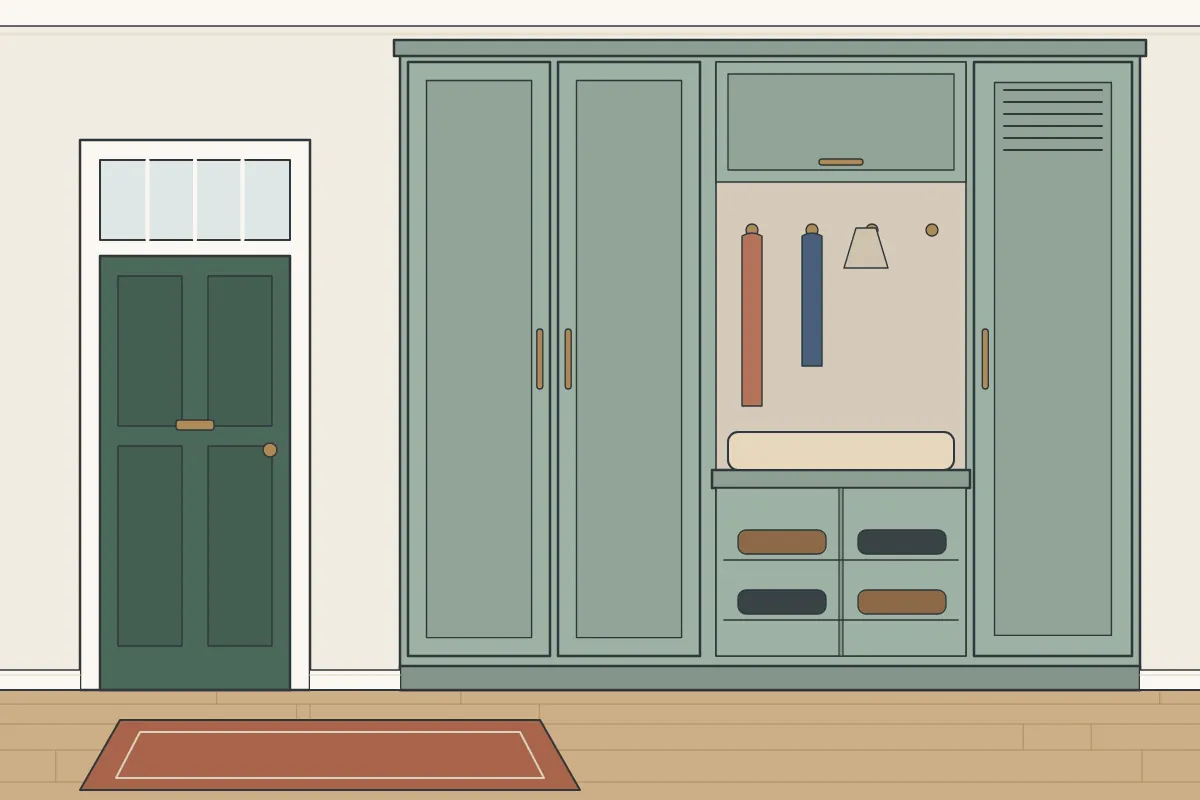
How fitting works for fitted cupboards
On the morning of the fitting, we start by protecting your floors and the route from the front door to the room. The sections made in our workshop come in next, a piece at a time. How long the fitting takes depends on the number of cupboards and the space they fit into, and your quote sets out the fitting days. Where a period house has been split into flats, the way in often goes through shared parts, so it helps to let neighbours know about fitting day. Each section is sized for the tightest door or turn. Saturday fitting is possible by arrangement.
- You let us know where the cupboards should go.
- At the design visit we measure at several points, as walls and floors in older homes are rarely flat or level.
- You receive a quote in writing covering the design, materials and finish.
- We make the cupboards in our workshop from moisture-resistant MDF and birch plywood.
- We fit the cupboards and trim the edges to follow the walls and ceiling.
- Your finish is sprayed beforehand or painted by hand on site; go gently with it at first while it cures.
Preparing the room
- Check the building’s rules for trades and lift bookings
- Keep pets in another room while we work
- Let us know about any meters, fuse boards or boilers in the area
Arranging a design visit
We quote once we have seen the room. At the visit, we measure, look at the walls and floors and talk through the design with you, and the written quote comes after. There’s no price list: each design is priced in writing after we’ve seen the space. To book a design visit, tell us about the room on our contact form.
Related advice
Materials and finishes
Birch plywood
Shelves that carry weight need a strong board, and birch plywood is a good fit. Span, depth and load all matter.
Plinths and scribe strips
Plinths and scribe strips are small parts that make a big difference in a room where nothing is quite square.
Nearby places to Chinatown
What else we make in Chinatown
When is bespoke worth it?
Long shelves are where off-the-shelf often struggles. Span, depth and the weight on it decide whether a shelf sags, so a long run needs a thicker shelf, a stiffening lip or a support. That is something we plan for in the design.
Standard units come in set widths and heights, so there’s typically a gap left over at the top or at one end. Furniture we make is built to the room’s own sizes, so it can use the full height and width.
Practical tips
These points come up often when people plan fitted cupboards. They’re worth knowing whatever the room:
- Mention any boiler, meter or fuse board early
- Have damp sorted before fitting
- Treat new paintwork gently at first
- Think about how the cupboards will get in
Meter and fuse board cupboards work best when they stay easy to open. Try not to fill the space in front of them, so they can be reached without a struggle.
Let us know about parking and access at the measuring visit. Many London streets are in controlled parking zones and some blocks need lifts or deliveries booked ahead.
Is it time for fitted cupboards?
Many flats come with little or no built-in storage. A cupboard in the hallway or a spare recess can change how the home works, particularly when it uses the full height of the room.
Most of the enquiries we get are about needs like these:
- Making use of an tricky alcove or corner
- Cupboards that suit a period house
- Tidying away the gas and electricity meters
- A hallway cupboard for coats and shoes
If you live near St Anne's Churchyard, fitted cupboards can be designed to hold outdoor kit, from walking boots to picnic things.
Before you choose who makes it
- Where they’ll park and unload
- Do they scribe the furniture to the walls?
- Whether you’ll get a written quote, not just a figure
- Who does any electrics, plumbing or gas work
Common questions about fitted cupboards
Does a conservation area in or near Chinatown affect fitted furniture?
Not normally. Conservation area controls are mainly about the outside of buildings, so fitted furniture inside a house doesn’t normally need planning permission. Listed buildings are different, as works inside that affect their character may need listed building consent from the council. The council’s planning or conservation team can tell you if in doubt.
Is Chinatown in the area you cover for fitted cupboards?
Yes. We cover all of Westminster and the rest of London, and Chinatown is part of that. The first step is a design visit, where we measure and discuss the design, and then we send a quote.
How long will the cupboards take to fit?
Every job is different. How long fitting takes depends on the size of the cupboards and the room, and we confirm the fitting days in your quote, so you will know before we start.
Do I choose the paint colour?
You choose it, and it’s agreed with you before painting. Whichever finish you pick, it’s in the colour you’ve chosen.
Should I send pictures?
Yes. Pictures help us understand the room before the design visit. It helps to show radiators, sockets and anything else on the wall.
What if the wall is cold or damp?
It can be done with some care: leaving ventilation behind and inside helps stop condensation. We don’t treat damp, so any damp should be sorted before fitting day.
Fitted cupboards for homes in Chinatown
About 50% of the homes in the streets around Chinatown went up before 1919, and about 23% since 2000, based on the Valuation Office Agency’s 2025 council tax data. Each era brings its own kind of wall, ceiling height and floor, so it shapes the design from the first measurement. There are 996 entries on the National Heritage List within half a mile of the centre of Chinatown. Older homes nearby may have original joinery, shutters or panelling worth keeping, and fitted cupboards can be designed to work around them. Streets close to central London are often narrow and busy, with loading bays in short supply, so the route from the van to your door is planned ahead of time, especially for larger pieces.
For an older house near St Anne's Church, an old boiler or airing cupboard can be rebuilt with proper shelves. The wider area includes historic houses like Benjamin Franklin House, about 0.4 miles south-east. If your own home is a period one, hallway recesses and alcoves are where fitted cupboards earn their keep.
Chinatown is about 1 mile west of City of Westminster, within the City of Westminster. We can visit homes in Chinatown on weekdays, or on a Saturday by prior arrangement. Across Westminster, we cover Chinatown, along with the rest of the borough.
Design visits and fitting in W1F, W1D and W1T work the same way as everywhere else we cover. You will find streets here such as Duck Lane, Drury Lane and Bruton Lane, and we cover homes on all of them for fitted cupboards. Chinatown is near the A4 and A301, so if your home is on a main road, mention it when you get in touch. If you’re just outside Chinatown, we also cover Soho (1 mile north), St James's (1 mile south), West End (1 mile north-east), Seven Dials (1 mile north-east) and St Giles (1 mile north-east). Elsewhere in Westminster, we also cover Paddington Green (2 miles west), Paddington (2 miles west), Lisson Grove (2 miles north-west), Westbourne (3 miles west), Little Venice (2 miles west) and Westbourne Green (3 miles west). Chinatown is among the bigger places we cover in Westminster.
Near you in Chinatown
Our area takes in the homes around LITE Regal International School, Harris Westminster Sixth Form and Waxy O'Connor's pub. Chinatown has its own railway station: Tottenham Court Road station. Nearby you will also find Leverian collection (a few minutes’ walk south-east) and Kingly Court (less than half a mile west). Not far away are St. James's Park Lake and Ludgate Hill.