
Westminster · London
Charing Cross Under-Stairs Storage
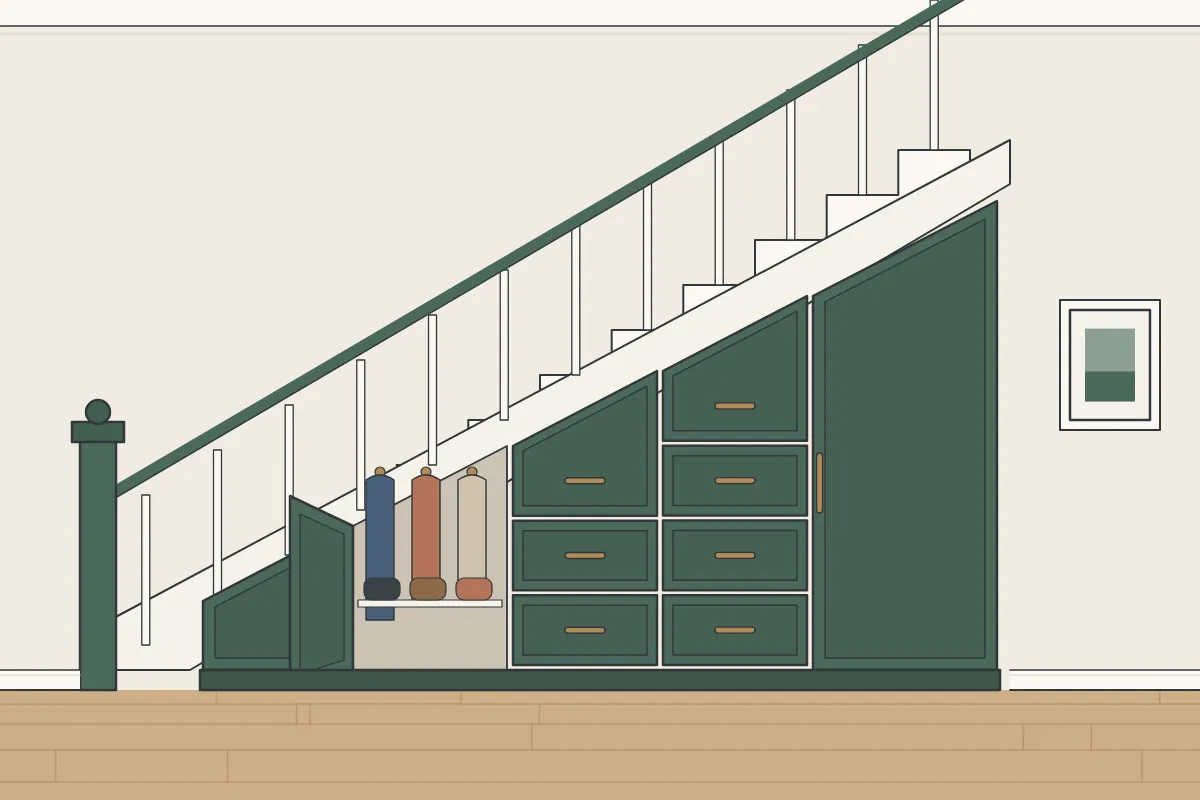
Under-stairs storage in Charing Cross: pull-out drawers, cupboards and coat storage under the stairs. Every piece is made at our workshop and fitted in your home, with a spray or hand-painted finish.
- A staircase with untidy space beneath it
- A sloping corner nobody can reach
- An old cupboard door that doesn’t suit the hall
Need under-stairs storage in Charing Cross?
What it is made from
Birch plywood
Drawers under the stairs often carry heavy things, from shoes to the vacuum cleaner. Birch plywood suits them, as it’s strong and holds screws well. It also suits longer shelves.
Pull-out drawers
Some pull-outs are tall, with a rail for coats or room for a vacuum. Lower drawers suit shoes, bags and boxes. We plan the mix during the design visit.
About our under-stairs storage in Charing Cross
In a narrow hallway, the stairs may offer the only spare room for coats and shoes. A hanging section, shoe drawers and a shelf for keys keep everything off the floor. Painted in a colour you choose, it reads as part of the house rather than a piece of furniture. For a home in Charing Cross, it can make the front door feel far calmer. We make under-stairs cupboards from birch plywood and moisture-resistant MDF with a spray-painted or hand-painted finish, and the things people most often want solved are a sloping corner nobody can reach and coats and shoes piling up in the hall.
In streets where many homes were built before 1919, as they were around Charing Cross, under-stairs cupboards in older terraces often house the meters or the fuse board. Those have to stay reachable, so any storage is designed around them. Bays and sash windows in period houses are natural spots for a window seat.
The written quote is your record of the job. It sets out the under-stairs cupboard designed for your room, its materials and its finish.
- Place
- Charing Cross (W1F, W1D, W1S)
- Area
- Westminster
- Prices
- Quoted for your room
- To begin
- We visit, measure, then quote
- Making
- Made in our workshop and fitted on site
- Boards and paint
- MDF and birch plywood, painted
- When we fit
- Monday to Friday; Saturdays by prior arrangement
- Enquiries
- Our contact form
- Page updated
- 27 October 2026
How fitting day works
Period rooms often have skirting boards, picture rails, cornices or coving for the furniture to meet. We cut and scribe the furniture around them on site, so it sits neatly against the room. How long the fitting takes depends on the size of the space and the design, and we confirm the fitting days in your quote. Where a period house has been split into flats, the way in often goes through shared parts, so neighbours may appreciate a note before fitting day. Each section is sized for the tightest door or turn. Saturday fitting is possible by arrangement.
- You get in touch with a few details and, if you like, a sketch. It is useful to say whether the meters are under there.
- At the design visit, we look at the stairs, the hall and what you need to store.
- Your quote sets out the design, the materials and the finish. Take your time to look through it.
- We make the drawers, doors and carcasses in our workshop.
- The storage is fitted and set level, ready for the first coats and shoes.
How to prepare
- Take down pictures, mirrors and shelves from the wall
- Clear the area where the furniture is going
- Let us know about any meters, fuse boards or boilers in the area
Starting with a design visit
It helps to see the room before we come. A few pictures showing the walls, the corners and where the ceiling meets them tell us a lot about the space, along with rough measurements. To share them, get in touch through our contact form, and we’ll arrange a design visit.
Advice
Flats, blocks and rented homes
Landlords furnishing a let use fitted furniture too, often to make the most of a small or tricky room. The materials are the same as for any home: moisture-resistant MDF and birch plywood, finished by spray or by hand.
In a flat, the route in matters as much as the room. At the design visit, we measure the stairs, the landings, any lift and the doors, so the furniture can be made in sections that fit through.
What affects the price in Charing Cross
The price for your room depends on:
- What goes inside: rails, shelves, drawers and dividers
- Whether you choose a spray or hand-painted finish
- How many doors and drawers there are
- Tricky walls, sloping ceilings and uneven floors
We quote each job for the room it’s going into, after the design visit. A larger piece means more material and more time, so size comes first. After that, the number of doors and drawers, the internal fittings and the finish all play a part.
What to send when you contact us
A little information at the start saves time later. If you can, send:
- A few pictures of the space, taken from the doorway and from each corner
- What the furniture needs to hold
- What kind of home it is, and which floor the room is on
- Where you live, with the postcode
Every quote follows a design visit. We measure the space, check the walls and floors and discuss what you’d like, then send a written quote. Your quote is written for your room once we’ve visited and measured. To book a design visit, message us from the contact page.
Under-stairs storage in Charing Cross: local notes
About 50% of the homes in the area around Charing Cross went up before 1919, and about 21% since 2000, according to Valuation Office Agency council tax figures (2025). Knowing roughly when a home was built helps, because walls and fixings change from one era to the next. Charing Cross is partly covered by the Trafalgar Square Conservation Area, one of the conservation areas recorded by Historic England. Conservation area controls are mostly concerned with the outside of buildings, and fitted furniture inside a house doesn’t normally need planning permission. If you want to be certain, ask the council’s planning team. TfL’s Ultra Low Emission Zone covers every part of London, Westminster included. It applies to every van that comes to fit furniture in Charing Cross. We plan parking and access with you at the measuring visit.
Near listed buildings like Church of St Martin in the Fields, less than half a mile north of the centre of Charing Cross, older homes may keep original joinery that under-stairs cupboards can be designed around. For a listed home, fixing into original features can need listed building consent. For a flat near London Charing Cross station, the lift, the stair turns and the front door all set the largest piece that can come in. Benjamin Franklin House, about 0.1 miles east, is one of the historic houses in the wider area. For a period home anywhere nearby, the triangle under an old staircase is often deeper than it looks.
Charing Cross is in the City of Westminster, about 1 mile north-west of City of Westminster. Charing Cross is part of the area we cover. Charing Cross is one of the places in Westminster where we make under-stairs storage.
Every home in W1F, W1D and W1S is covered for under-stairs storage. Whether you live on a street such as Duck Lane, Drury Lane and Bridle Lane or on one nearby, we can arrange a design visit for under-stairs storage. The A4 and A301 run close to Charing Cross; on busy main roads, unloading under-stairs cupboards takes a little planning. Nearby, we also make under-stairs storage in St James's (1 mile west), Adelphi (1 mile north-east), Chinatown (1 mile north-west), West End (1 mile north) and Covent Garden (1 mile north-east). Across the rest of Westminster, our area takes in Paddington Green (2 miles north-west), Paddington (2 miles west), Connaught Village (2 miles west), Lisson Grove (2 miles north-west), Westbourne (3 miles west) and Little Venice (3 miles west).
Around Charing Cross
We fit furniture in homes around Silver Cross Tavern, Westminster Abbey Choir School and London Library and the streets around them. Charing Cross has its own railway station: London Charing Cross station. Well-known places in the area include Kingly Court (0.6 miles north-west) and Montfichet's Tower (1.2 miles east). For a walk, there is St. James's Park Lake and Ludgate Hill.
When you need someone else
Electrics, plumbing, gas, plastering and structural work are not part of what we do. There are a few other points to bear in mind:
- Moving a gas or electricity meter, which is arranged through your energy supplier
- Any work on gas pipes or appliances
- Reshaping or rebuilding the staircase
Not sure whether your space suits under-stairs storage? You can get in touch through our contact form and we will tell you before you arrange a visit. How a job runs, step by step.
What goes into it
- Pull-out drawers
- Coat hooks and shoe shelves
- Birch plywood
- Moisture-resistant MDF
- Hand-painted finish
- Spray-painted finish
Neighbourhoods near Charing Cross
Also in Charing Cross
Common questions about under-stairs storage
Do you make under-stairs storage for homes in Charing Cross?
Yes, Charing Cross is within the area we cover, which takes in all of Westminster and the rest of London. The first step is a design visit, where we measure and discuss the design, followed by a quote.
My house in Charing Cross is Victorian. Can you deal with uneven walls?
Yes. Walls in older houses are rarely flat or square, and floors are often out of level, so each piece is scribed to follow the wall and set level on a plinth or adjustable feet. Skirting, picture rails and cornices are met neatly or cut around. Fixings are chosen for the wall, whether solid brick or lath and plaster.
What materials do you use for under-stairs storage?
The storage is made from moisture-resistant MDF and birch plywood. MDF is stable and takes paint well, so it suits the doors and fronts, and birch plywood is strong, so it suits drawer boxes and carcasses. The finish is spray-painted or hand-painted.
Does someone need to be home during the fitting?
We need someone to let us in. It is good to have someone there at the end to look over the work with us.
Can you add sockets inside the units?
No. Any new wiring, sockets or lights need an electrician, and some electrical work in homes is covered by Part P of the Building Regulations. We’ll design around them.
Is it possible to have a desk built under the stairs?
In many homes it’s possible, if the space is open to a room and tall enough at one end. We can build a desk with shelves and drawers to suit the space. New sockets or lights are for your electrician, and we leave a route for the cables.