
Example photo by Olena Bohovyk on Unsplash, not our project
Westminster · London
Walk-in Wardrobes in Chinatown
Thinking about walk-in wardrobes in Chinatown? It starts with a design visit to measure and talk through ideas, then a quote in writing, before anything is made.
- A walk-in wardrobe in a box room
- A built-in dressing table
- Separate space for two people’s clothes
Ask about walk-in wardrobes in Chinatown
Walk-in wardrobes in Chinatown
A walk-in wardrobe gives your clothes a room of their own. We build them in spare rooms, box rooms and corners of bedrooms, fitted out with hanging, shelves and drawers. Everything is built in our workshop and fitted to the room, scribed to the walls and set level. If your home has a dressing area in part of a bedroom and hanging for coats, dresses and shirts, that’s what walk-in wardrobes are for, made from moisture-resistant MDF and strong birch plywood, with a painted finish.
In a Victorian bedroom, the chimney breast usually sits on a side wall, with a recess to each side. A large share of the homes around Chinatown date from before 1919, so many bedrooms there may share that layout. Storage can go in each recess, with a bridge of cupboards over the chimney breast, leaving the breast itself clear. The flue behind is kept ventilated, and any damp is sorted first.
A written quote is the clearest record of what we’ve agreed. It sets out the walk-in wardrobe designed for your room, its materials and its finish.
- Location
- Chinatown (W1F, W1D, W1T)
- Area
- Westminster
- Price
- Quoted for your room
- First step
- We visit, measure, then quote
- Making
- In our workshop, then fitted in your home
- Boards and paint
- Painted MDF and birch ply
- Fitting days
- Monday to Friday; Saturdays by prior arrangement
- Get in touch
- Our contact form
- Updated
- 27 October 2026
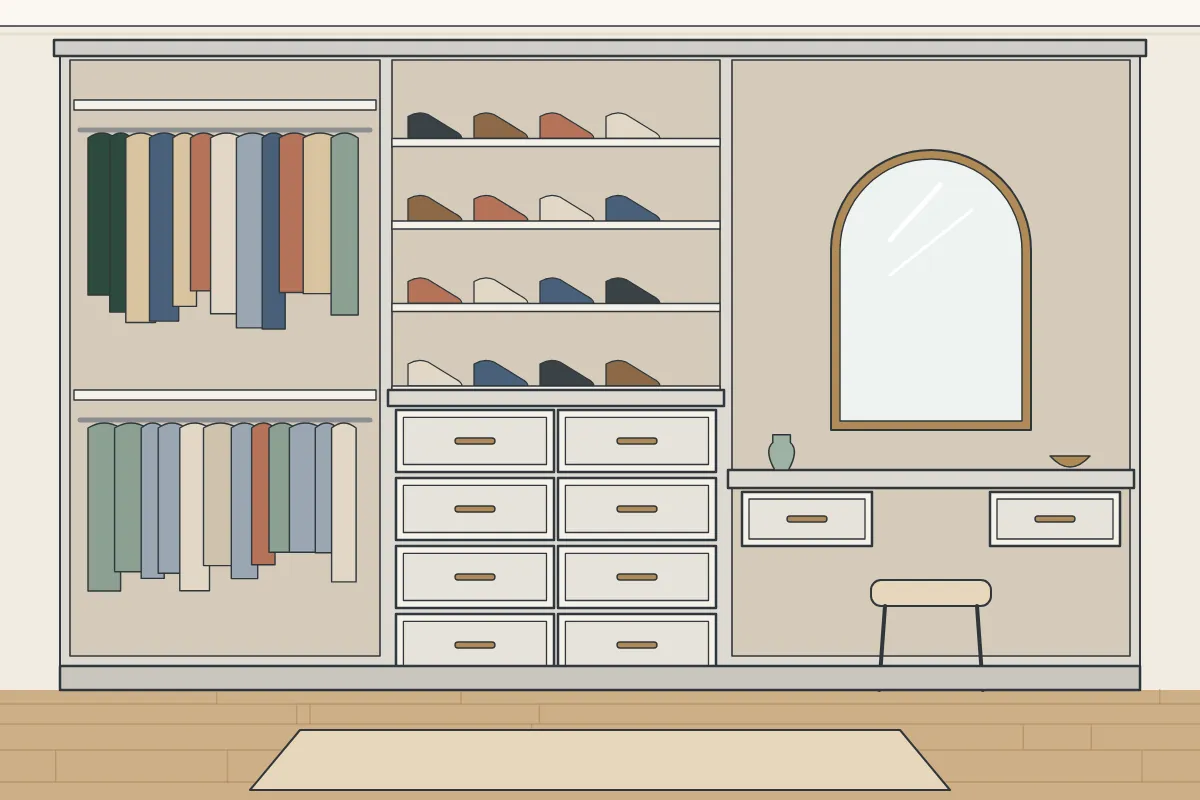
Bedroom storage in Chinatown
About 50% of the homes in the streets around Chinatown went up before 1919, and about 23% since 2000, on the Valuation Office Agency’s council tax figures for 2025. It’s a good starting point, though every room is still measured, as two homes of the same age rarely match. Chinatown is partly covered by the Leicester Square Conservation Area, according to Historic England’s records. Conservation area controls are largely about how buildings look from outside, and fitted furniture inside a house does not normally need planning permission. The council can confirm if you’re not sure. Streets close to central London are often narrow and busy, with loading bays in short supply, so carrying the sections from the van to the door takes planning.
The wider area includes historic houses such as Benjamin Franklin House, about 0.4 miles south-east. If your own home is a period one, solid external walls can be cold, so ventilation behind walk-in wardrobes is part of the design. Living in a block of flats near Tottenham Court Road station? Then each piece is planned so it can be carried up and joined together in the room. Close to St Anne's Churchyard? Walk-in wardrobes are typically planned on the walls away from the window, so the light and the view stay.
Chinatown is within the City of Westminster, about 1 mile west of City of Westminster. Homes in Chinatown are part of the area we cover for walk-in wardrobes. In Westminster, Chinatown is one of the places we cover, and the borough has 29 places on our list.
We work across W1F, W1D and W1T for walk-in wardrobes. You’ll find streets here like Duck Lane, Drury Lane and Bruton Lane, and homes on each of them are within our area for walk-in wardrobes. Main roads around Chinatown include the A4 and A301, and we plan where the van can stop before fitting day. Nearby, we also make walk-in wardrobes in Soho (1 mile north), St James's (1 mile south), West End (1 mile north-east), Seven Dials (1 mile north-east) and St Giles (1 mile north-east). Other parts of Westminster we cover include Paddington Green (2 miles west), Paddington (2 miles west), Lisson Grove (2 miles north-west), Westbourne (3 miles west), Little Venice (2 miles west) and Westbourne Green (3 miles west). Chinatown is among the bigger places we cover in Westminster.
Landmarks near Chinatown
Around Chinatown, we cover homes near LITE Regal International School, Harris Westminster Sixth Form and Waxy O'Connor's pub. There is a railway station in Chinatown itself: Tottenham Court Road station. A little further out are Leverian collection (within half a mile south-east) and Kingly Court (less than half a mile west). Green spaces nearby include St. James's Park Lake and Ludgate Hill.
Places near Chinatown
What else we make in Chinatown
What walk-in wardrobes can’t fix
Some parts of a job need another trade, such as an electrician, a plumber or an engineer on the Gas Safe Register. Here’s what to know:
- New lights or sockets
- Fixing the cause of damp
- Building a new partition wall
If you’re not sure what’s possible in your room, you can drop us a line using the contact form and we’ll give you a straight answer before you arrange a visit. How a job runs, step by step.
Materials and parts
- Shoe storage
- Dressing table
- Hanging, shelves and drawers
- Hand-painted finish
- Moisture-resistant MDF
- Spray-painted finish
- Birch plywood
FAQs: walk-in wardrobes in Chinatown
Is Chinatown in the area you cover for walk-in wardrobes?
Yes, we work across Westminster, Chinatown included, and across the rest of London. To get started, you can send us a few details through our contact form with some details.
I live in a flat in Chinatown. How will the furniture get up the stairs?
We measure the route in as well as the room: the stairs, landings, lift and doors. Walk-in wardrobes are made in our workshop in sections sized to fit that route, then assembled in your flat. It helps to check any building rules and your lease before fitting day.
Can you fit furniture to uneven walls?
Walls and floors that are not true are part of the job in older homes. We trim the edges to follow the wall and level the base.
What if the wall is cold or damp?
It needs a little planning: ventilation behind and inside the furniture helps avoid condensation and mould. We do not treat damp, so any damp should be sorted before fitting day.
Do you move sockets or add lighting?
No. Any new wiring, sockets or lights need an electrician, and some electrical work in homes is covered by Part P of the Building Regulations. We’ll design around them.
Do I need doors on a walk-in wardrobe?
That depends on how you like to use the space. Doors, open rails and shelves can all be combined, and we go through the options when we measure.
Why bespoke in Chinatown?
Modular units are made in fixed sizes and rarely reach the ceiling. We can build right up to the ceiling and from wall to wall, so very little space goes to waste. Chimney breasts in older houses stand out by different amounts, so the recesses either side are rarely the same, which means a matching pair of ready-made units seldom fits both. Each side can be made to its own size.
Every room is priced on its own, because the size, the layout and the finish all vary. A spray finish and a hand-painted finish involve different work, and that shows in the price. You’ll see the figure in your written quote, after the design visit.
Why us?
- A spray or hand-painted finish
- Every London borough and the City of London covered
- Workshop-made and fitted by us
- Built from moisture-resistant MDF and birch plywood
Materials and finishes
Hand-painted finish
Some people like the character of a hand-painted finish in an older home.
Birch plywood
Drawers are opened every day, so we make them strong.
DIY, flat-pack or bespoke
It is worth being honest about cost: flat-pack is usually cheaper to buy. Bespoke earns its place where the room is tricky, space is tight or you want the furniture to look part of the house.
The real difference is in the fit: edges scribed to the wall, a level base on a sloping floor and a neat line where the furniture meets the ceiling. In an older room, standard units rarely manage that.
Fitting day, step by step
The last stage of the day is the finish. With a spray finish from the workshop, there’s normally only filling and touching up to do in the room; hand painting, if that’s what you chose, can be done in place once everything is fitted. Either way, the finish is the one set out in your quote. Scribing is done on site, which means some cutting in the room or close by, so a clear area to work in near the room helps. Dust is kept down and cleared up as we go. Hand painting, if that is your finish, can follow the fitting.
- It starts with a short note from you.
- At the design visit we measure the walls, floor and ceiling at several points, as few rooms are truly square.
- You receive a quote in writing covering the design, materials and finish.
- We make the walk-in wardrobe in our workshop from moisture-resistant MDF and birch plywood.
- On fitting day each unit is levelled and scribed to follow the walls.
- We check everything with you, and fresh paint should be treated gently at first.
Before we arrive
- Let us know if your street is in a controlled parking zone
- Empty the space we’ll be working in
- Check the building’s rules for trades and lift bookings
Arranging a design visit
The quote is built from the design visit. We measure the room properly, check how the walls and floors run and go through the design with you. A quote in writing follows the visit for you to look over. To arrange the visit, use our contact form.