
Example photo by Franco Debartolo on Unsplash, not our project
Camden · London
Window seats in North End, Camden
Thinking about window seats in North End? We start with a design visit and a written quote, before anything is made.
- A ready-made bench that does not fit the bay
- A child’s room that needs storage and seating
- A bay with no furniture that fits
Need window seats in North End?
North End homes and window seats
The biggest shares of homes in the area around North End were built before 1919 (about 52%) and between 1919 and 1939 (about 17%), on the Valuation Office Agency’s council tax figures for 2025. The age of a home tells us a lot about its walls, floors and ceilings, and so about how window seats are fixed and fitted. The National Heritage List has 71 entries within half a mile of the centre of North End. Older homes nearby may have original joinery, shutters or panelling worth keeping, and window seats can be designed to work around them. About 52% of homes in the neighbourhood around North End were built before 1919, according to Valuation Office Agency council tax figures (2025). Bays and sash windows in period houses suit a seat with drawers or a lift-up lid.
For a family home near The King Alfred School, a place for each person’s coat and shoes stops the hallway filling up. For a flat near Hampstead Heath station, window seats are made in sections sized for the stairs, landings and lift, so measuring the route matters as much as measuring the room. If you live in a period home close to Church of St Alban the Martyr, a bay or a sash window is a natural place for a window seat.
North End is in the London Borough of Camden, about 4 miles south-east of St Pancras. Anywhere in North End, it works the same way: we visit and measure, send a quote in writing, make the furniture in our workshop and fit it. Across Camden, we cover North End and the places around it.
Postcode districts we cover here for window seats: NW3, NW11 and N2. Streets in the area include Sandy Road, Park Avenue and Platt's Lane, and homes on each of them are within our area for window seats. North End is near the A502, so if your home is on a main road, mention it when you contact us. Neighbouring places we cover for window seats include Vale of Health (1 mile south-east), Childs Hill (1 mile south-west), Golders Green (1 mile north-west), Greenhill (1 mile south) and West Hampstead (1 mile south). Elsewhere in Camden, we also cover St Pancras (4 miles south-east), West End (4 miles south-east), St Giles (4 miles south-east), Seven Dials (4 miles south-east), Holborn (4 miles south-east) and Bloomsbury (4 miles south-east).
Landmarks near North End
Our area takes in the homes around Christ Church Primary School, The Old Bull and Bush pub and The Henrietta Barnett School. The nearest railway station is Hampstead Heath station, roughly 1.1 miles south-east of the centre. Well-known places in the area include Kenwood House (0.6 miles east) and O2 Centre (1.4 miles south). Not far away are Parliament Hill and Turner's Wood.
About our window seats in North End
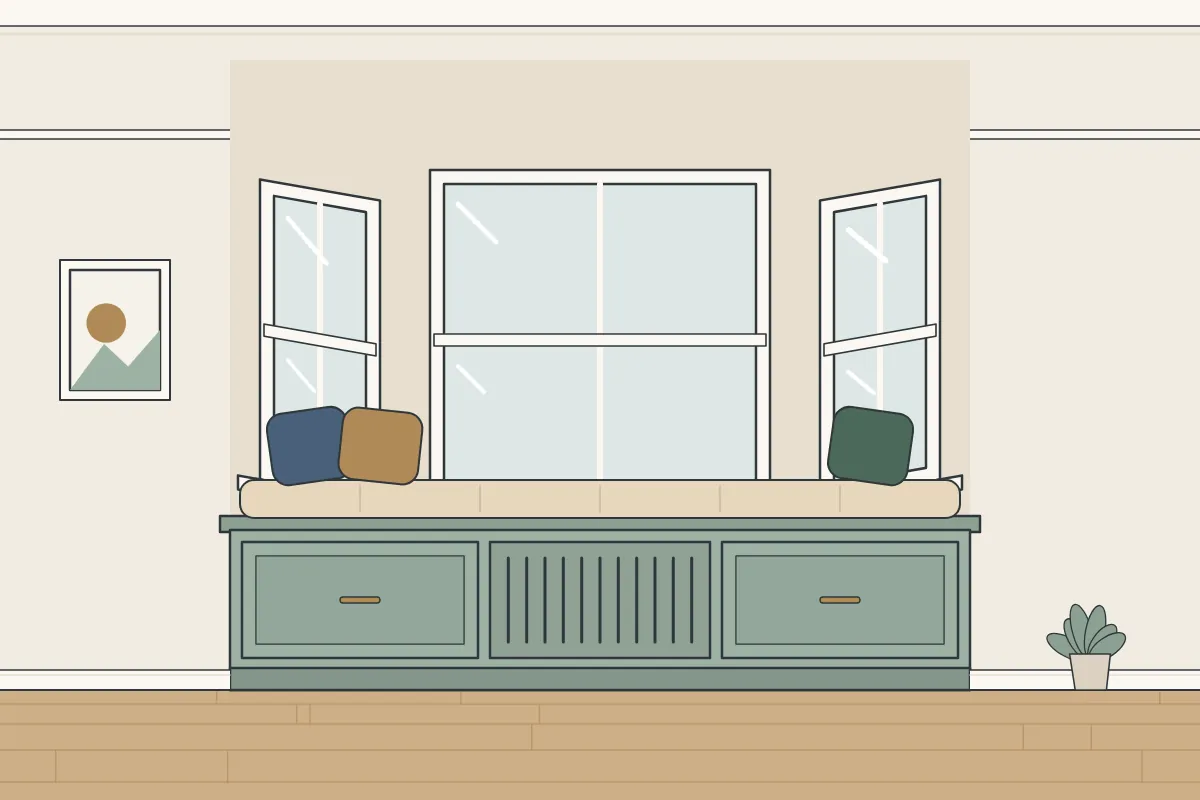
Many windows have a radiator beneath them. A seat built over a radiator needs a grille or an open front, so the heat is not trapped. We design the grille into the front of the seat and leave space around the radiator. We’ll look at your radiator at the design visit in North End. We make window seats from birch plywood and moisture-resistant MDF with a spray-painted or hand-painted finish, and the things people most often want solved are wanting a seat without blocking the radiator and wanting new furniture to sit well in an older room.
Outside walls in houses from before 1919 are usually solid brick, which can be cold, so a gap and ventilation behind fitted storage help avoid condensation. A large share of the homes around North End date from then. Damp should be sorted before anything is fitted against the wall.
Once you’ve read the quote and decided to go ahead, the furniture is built in our workshop. The quote sets out the agreed design, materials and finish, so you can check every detail beforehand.
- Place
- North End (NW3, NW11, N2)
- Borough
- Camden
- Prices
- Quoted for your room
- How it starts
- We visit, measure, then quote
- Made
- In our workshop, then fitted in your home
- Made from
- Painted MDF and birch ply
- Working days
- Weekdays (Saturdays if arranged)
- Get in touch
- Our contact form
- Page updated
- 27 October 2026
Nearby places to North End
Other services in North End
What it is made from
Doors and drawer fronts
A radiator grille sits in the front of the seat, letting the heat reach the room. It is painted to match the other fronts. The rest of the front can be drawers, doors or plain panels.
Moisture-resistant MDF
Because it cuts cleanly, MDF is ideal for angled panels and radiator grilles. We use a moisture-resistant grade, which is stable and takes paint well. Most of what you see on the finished seat is MDF.
How fitting works for window seats
At the end, we tidy up and lift the floor protection. Before we leave, we go over the finished piece together and explain how to look after the paint. The time the fitting takes depends on the shape of the bay or recess and what goes under the seat, and your quote sets out the fitting days. Older London houses often have narrow hallways and tight turns on the stairs, so window seats are made in sections sized to get through. Floors and stair carpets are protected on the way in and out, and the sections are joined and scribed in the room.
- You get in touch and let us know about the window and the room.
- At the design visit we measure the bay or recess and check the radiator, cill and any shutters. We also talk about lift-up lids or drawers.
- A written quote follows, with the design, finish and fitting days set out, for you to look over.
- We make the seat, the lids or drawers and any grille in our workshop. We use moisture-resistant MDF and birch plywood.
- We fit it in your home, scribed to the walls and the floor.
Before we arrive
- Clear the area where the furniture is going
- Tell us about any meters, fuse boards or boilers in the area
- Check the building’s rules for trades and lift bookings
How to get a quote
The design visit is where every quote starts. We take full measurements, see how true the walls and floors are and work through the design together. Afterwards, we send a quote in writing for you to look over. To book one, send us a few details through our contact form.
Read more
Honest limits
We’d rather be clear about where our work stops:
- New sockets or lights near the window, which are for your electrician
- Plastering and decorating around the seat
- Repairs to sash windows, cills or shutters
Not sure whether your space suits window seats? You can send us a few details through our contact form and we will tell you before you arrange a visit. How it works.
Materials and parts
- Lift-up lids or drawers
- Radiator grilles
- Birch plywood
- Spray-painted finish
- Hand-painted finish
- Moisture-resistant MDF
Bespoke or off-the-shelf?
A ready-made bench is built for a flat wall and a square corner, and bay windows rarely offer either. In a bay, a standard bench leaves tricky gaps. A bespoke seat follows the shape of the bay. It costs more than a bench, and what you get is a seat that belongs to the room. Off-the-shelf furniture is made for flat walls and level floors, which older houses rarely have, so it leaves gaps at the wall, tilts on sloping floors or sits awkwardly against skirting and picture rails. Fitted furniture is scribed to the wall instead.
We quote each job for the room it’s going into, after the design visit. The price depends mainly on the size of the piece, how many doors and drawers it has and what goes inside.
Why choose us
- Built in our workshop and fitted in your home
- Saturday visits and fitting by prior arrangement
- Edges scribed to follow your walls
- Every quote follows a design visit
Take a look at bespoke vs off-the-shelf and how to compare quotes.
Your questions about window seats in North End
My house in North End is Victorian. Can you deal with uneven walls?
Yes. Walls in older houses are rarely flat or square, and floors are often out of level, so each piece is scribed to follow the wall and set level on a plinth or adjustable feet. Skirting, picture rails and cornices are met neatly or cut around. Older walls can be solid brick or lath and plaster, and the fixings are chosen to suit.
Does a conservation area in or near North End affect fitted furniture?
Usually not: conservation area rules mainly cover the outside of buildings, and fitted furniture inside a house does not normally need planning permission. Listed buildings are different, as works inside that affect their character can require listed building consent from the council. If you are unsure, the council can confirm.
Does someone need to be home during the fitting?
We need access, so someone has to let us in. After that, you do not need to stay in the room, but it helps to be around at the end.
Can you come on a Saturday?
Yes, we can arrange Saturdays. Just mention it when you get in touch, and we will see what we can do.
Can you build a window seat over a radiator?
Yes. Many windows have a radiator beneath, and we design the seat around it. The front includes a grille so the radiator keeps working. Anything stored over the radiator will stay warm, so we plan the storage with that in mind.
Do pictures help?
Yes, they help. A few pictures of the room, from floor to ceiling, tell us a lot, particularly with rough measurements. To send them, send us a few details through our contact form.
Looking after your furniture
Getting the most from window seats starts with the planning and carries on after fitting day. These are worth keeping in mind:
- Consider how often you’ll reach for what’s stored
- Decide on cushion thickness before the design visit
- Bring paint colours you like to the design visit
- Check whether there’s a radiator under the window
Small marks on a hand-painted finish can be touched in. It’s worth keeping a record of the paint colour. Spray-painted surfaces wipe clean with a soft, damp cloth.
Lift lids gently and lower them carefully. It keeps the hinges and edges in good order. Don’t overfill drawers, as heavy loads strain the runners.